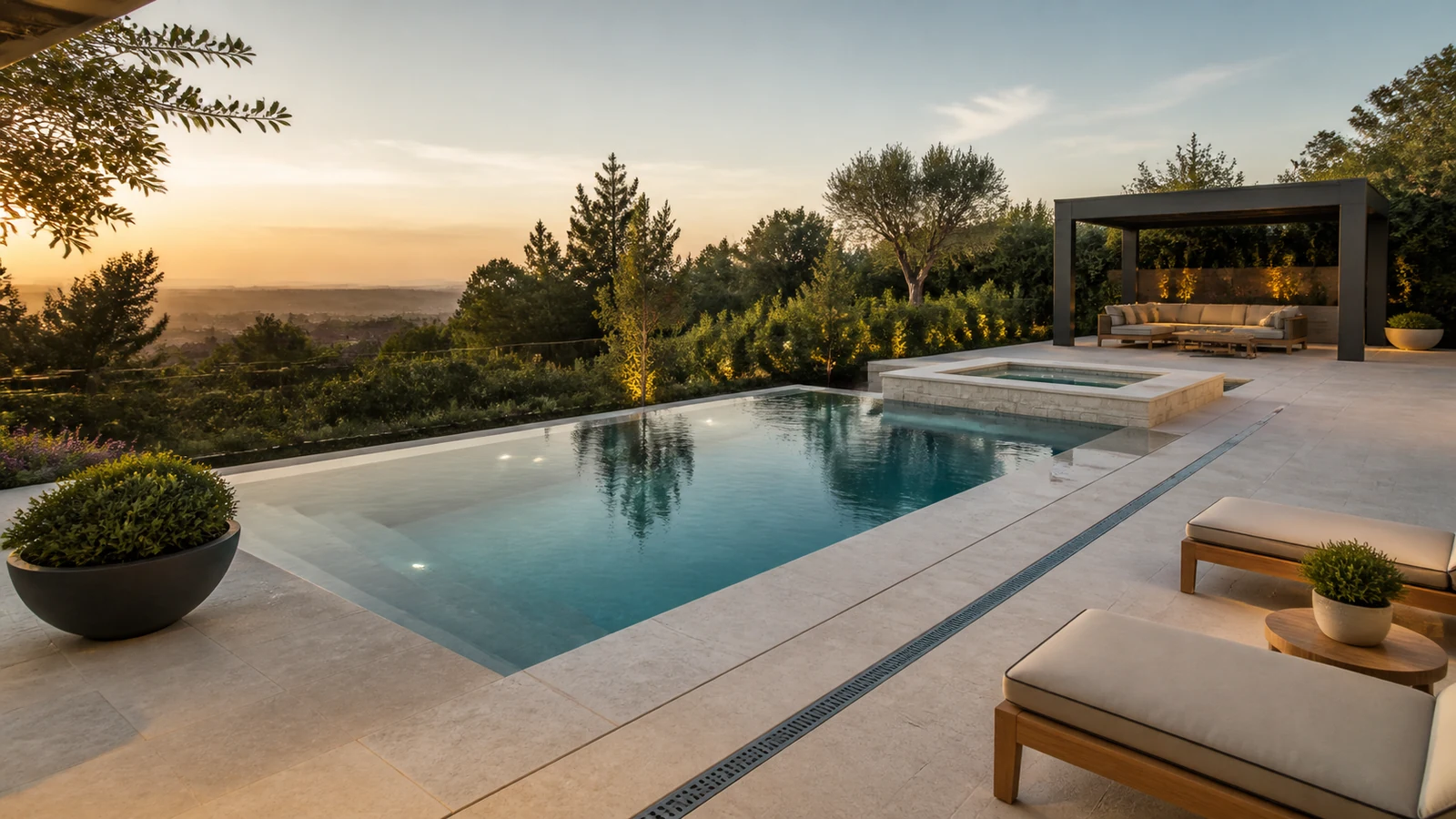
The best luxury pool design ideas do more than create a beautiful view. They make the pool easier to use, simpler to maintain, safer for the household and better integrated with the rest of the backyard. This guide brings architecture, automation, efficiency and everyday ownership into one practical plan.
Luxury pool design at a glance
| Priority | High-impact choices | Ownership benefit |
|---|---|---|
| Architecture | Clean geometry, integrated spa, tanning ledge | A more intentional, cohesive backyard |
| Comfort | Shade, seating zones, heating, wind protection | More usable hours and a longer season |
| Automation | Lighting scenes, schedules, remote monitoring | Fewer repetitive tasks and faster control |
| Maintenance | Automatic cover, robot access, low-debris planting | Less cleaning and more predictable care |
| Efficiency | Right-sized equipment, variable-speed circulation, cover | Lower water and energy waste |
| Safety | Code-compliant barriers, lighting, compliant drain covers | Risk reduction designed in from day one |
15 luxury pool design ideas worth planning
1. Start with clean, restrained geometry
Rectangular and softly linear pools work well in contemporary backyards because they give every other element a clear reference line. Coping, decking, pergolas and outdoor furniture can all follow the same geometry. Curves can be equally elegant, but they should respond to the architecture or landscape rather than being added without a reason.
2. Use an infinity edge only where the site supports it
A vanishing edge is most convincing on a sloped site, overlooking a garden, valley, lake or open horizon. On a flat lot, a perimeter overflow or a carefully detailed raised wall may create a cleaner result with less structural and hydraulic complexity. Ask the designer to explain surge capacity, balance-tank access and the maintenance plan before approving the effect.
3. Integrate the spa into the composition
An attached spa can feel like part of the architecture instead of an afterthought. Align its coping with the pool, repeat the same finish palette and decide whether the spillway should be subtle or deliberately audible. Separate controls for temperature, jets and lighting make the spa easier to use without running the entire pool system.
4. Add a tanning ledge with a clear purpose
A shallow ledge can serve as an in-water lounge, a place for supervised young swimmers or a transition into deeper water. Size it around the furniture or activity you actually expect. Confirm finished water depth before construction; a few inches can determine whether a chair sits comfortably or floats.
5. Create one memorable social zone
A sunken conversation pit, swim-up counter or poolside fire feature can become the visual anchor of the backyard. One well-resolved social zone is usually stronger than several competing features. Keep circulation paths dry and direct, and place food, glassware and electrical equipment with local safety rules in mind.
6. Design shade as part of the architecture
A pergola, pavilion or retractable canopy adds comfort and gives the pool area a stronger sense of enclosure. Orient it for the hours when the space will be used most, not only for the position of the midday sun. Integrating power, lighting and drainage during construction is cleaner than retrofitting them later.
7. Limit the material palette
Luxury often comes from consistency. Repeat two or three materials already present on the home—such as limestone-toned porcelain, warm timber and dark metal—rather than introducing a new finish at every surface. Specify slip resistance and suitability for freeze-thaw conditions where relevant; a beautiful sample is not enough.
8. Plan layered lighting, not just bright lighting
Combine underwater illumination with low-level path lights, subtle step lighting and warm landscape accents. Separate circuits or smart scenes can support swimming, entertaining and quiet evening use. Avoid aiming strong light toward neighboring properties or across the waterline, where glare can make the pool less comfortable.
9. Make an automatic cover part of the design
A well-integrated cover recess can preserve clean lines while reducing debris and evaporation. The U.S. Environmental Protection Agency notes that pool covers retain heat and, when used properly, can prevent up to 95% of evaporation. That makes the cover both a maintenance feature and an efficiency feature. See the EPA WaterSense pool guidance for the underlying recommendation.
10. Give automation a proper equipment strategy
Smart controls work best when the electrical panel, valves, sensors, network connection and service access are planned together. Decide which functions genuinely need remote control: schedules, pump speed, heating, lighting, spa mode and selected water-quality alerts are common priorities. Keep essential manual controls available so a lost internet connection does not make the pool unusable.
11. Right-size circulation and heating
Bigger equipment is not automatically better. Ask the builder to document flow requirements, pipe sizing, target turnover assumptions and heating expectations. A variable-speed pump can operate at lower speeds for routine filtration and increase output only when features require it. If extending the season matters, compare operating climate, noise, installation requirements and expected use in our guide to the best pool heat pumps.
12. Choose landscaping that will not fight the pool
Planting should frame views and soften hard surfaces without creating constant leaf, flower or seed drop. Favor species suited to the local climate, keep aggressive roots away from structures and leave enough access for cleaning and repairs. Layered evergreen planting can create privacy while reducing seasonal debris.
13. Design for robotic cleaning
Even a premium pool accumulates dust, pollen and organic debris. Provide a dry, shaded place for the cleaner and caddy, a safe route to the water and a convenient power location for corded models. Pool shape, steps, ledges and the waterline all affect cleaner compatibility. Start with our robotic pool cleaner guide, then verify the selected model against the finished pool.
14. Extend the design beyond the water
The pool becomes more useful when nearby zones support real routines: a compact outdoor kitchen, shower, towel storage, weatherproof audio or a movie wall can add more daily value than another decorative water feature. Keep wet and dry circulation clear, and specify outdoor-rated electrical products installed to local code.
15. Treat safety as a design layer
Barriers, gates, lighting, depth transitions and compliant suction fittings should be resolved early. The U.S. Consumer Product Safety Commission publishes home pool barrier guidance and separate information on pool and spa drain covers. Local building codes and a qualified pool professional remain the controlling requirements for a specific project.
Where to spend first
When the budget cannot cover every idea, prioritize the choices that are difficult to change after construction:
- Structure and hydraulics: pool shape, elevations, plumbing, drainage and equipment access.
- Safety and electrical infrastructure: barriers, bonding, lighting circuits and service capacity.
- Cover and efficiency: cover recess, correctly sized circulation and heating provisions.
- Comfort: shade, seating, steps and a practical path between the home and pool.
- Automation: a reliable control foundation that can support later additions.
- Decorative upgrades: furniture, styling and nonessential features that can be phased in.
A realistic maintenance plan for a luxury pool
Premium finishes do not eliminate routine care. Before approving the design, confirm how debris will move toward skimmers, how steps and ledges will be brushed, where the cover drains, how the waterline will be cleaned and how technicians will reach every valve and component. Review filters, baskets and water balance at a frequency suited to bather load, climate and manufacturer guidance.
For automation, separate convenience from measurement. Remote schedules and mode changes can be highly useful, but consumer sensors still need periodic validation with an appropriate test method. A good system reduces repetitive work; it does not remove the need to inspect the water and equipment.
Frequently asked questions
What makes a pool look luxurious?
Proportion, material consistency, controlled lighting and a strong relationship to the home matter more than the number of features. Concealed service elements and well-planned landscaping also make the finished space feel calmer.
Which smart features are most useful?
For many owners, scheduled variable-speed circulation, heating control, lighting scenes, spa mode and selected alerts deliver the clearest everyday benefit. The right list depends on the existing equipment and how the pool is used.
Is an infinity pool always worth it?
No. It has the strongest visual effect when the site offers a genuine horizon or grade change. It also adds structural, hydraulic and maintenance requirements that should be priced before design approval.
Does a pool cover really reduce water loss?
Yes. Evaporation is a major source of pool water loss, and the EPA recommends covers as an effective control. Actual savings vary with climate, pool temperature, wind and how consistently the cover is used.
What should be decided before construction starts?
Finalize the pool geometry, elevations, access, safety plan, equipment location, cover type, lighting circuits, heating expectation and future automation capacity. These decisions are harder and more expensive to revise later.
Build the design around ownership
The most successful luxury pool design ideas balance visual impact with the realities of cleaning, water care, safety and operating cost. Start with the permanent infrastructure, choose a restrained material palette, and add smart features only where they make ownership meaningfully easier. The result will feel better on opening day—and remain enjoyable long after the photographs are taken.