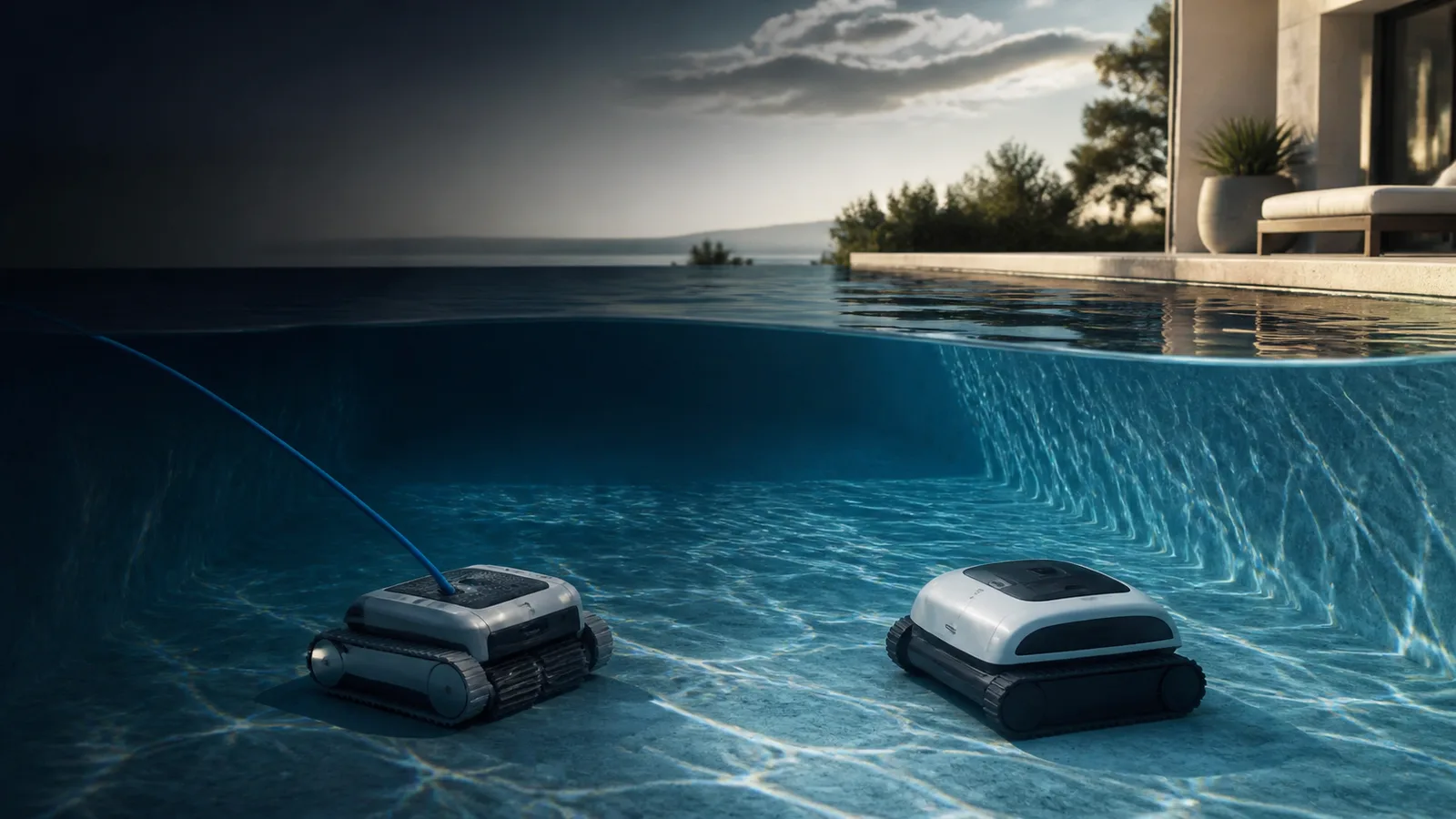
Dolphin vs Aiper: the CC Plus and Scuba S1 comparison is fundamentally a choice between continuous corded power and cordless convenience. The Dolphin focuses on a predictable two-hour floor-and-wall cycle, while the Aiper removes the cable, adds selectable modes and relies on a rechargeable battery.
The right choice is less about which brand is “better” and more about which routine you prefer. Do you want a robot that can run another cycle immediately, or a cleaner that leaves no power cable on the deck? This comparison uses current manufacturer specifications and makes that tradeoff explicit.
Dolphin vs Aiper: CC Plus and Scuba S1 at a glance
| Feature | Dolphin Nautilus CC Plus | Aiper Scuba S1 |
|---|---|---|
| Power | Corded | Rechargeable battery |
| Rated pool size | In-ground pools up to 40 ft. | In-ground pools up to 1,600 sq. ft. / 50 ft. |
| Coverage | Floor and walls | Floor, walls and waterline transition with selectable modes |
| Cycle/runtime | 2-hour default cycle | Up to 180 minutes on current US specification |
| Navigation | Internal scanning/navigation system | WavePath 2.0 systematic patterns |
| Filter | Top-access fine filter kit; bundle varies | 3.5L top-load basket; 180-micron and replaceable 3-micron options listed |
| Main advantage | No charging; immediate repeat cycles | No floating cable |
| Main tradeoff | Cable handling and storage | Charging, battery aging and retrieval routine |
Manufacturer specifications can change by product year, region and bundle. Verify the exact SKU before ordering.
For more alternatives, see our guide to the best robotic pool cleaners by pool type.
Cleaning coverage
Maytronics’ official CC Plus manual specifies floor-and-wall coverage and a two-hour default cycle. It is not listed as a dedicated waterline-scrubbing model. That makes its promise easy to understand: routine debris pickup and surface agitation across the main shell of an in-ground pool. Our Dolphin Nautilus CC Plus review covers ownership details in depth.
Aiper’s current Scuba S1 specifications list floor, wall, automatic and periodic/eco modes. The current design uses caterpillar treads and WavePath 2.0, with systematic floor and wall patterns. The product can climb through the wall-to-waterline area, but buyers who expect sustained horizontal tile-line movement should step up to a model explicitly built around that feature, such as the Scuba S1 Pro or certain premium corded cleaners.
Edge: Tie for normal floor-and-wall maintenance. The Aiper offers more selectable modes; the Dolphin offers a simpler repeatable cycle.
Corded vs. cordless convenience
The cable is the central buying decision. The Dolphin’s anti-tangling swivel reduces twisting as the robot changes direction, but the owner still needs to uncoil, place, retrieve and store a floating cable. In a well-planned equipment area this may be a minor chore; on a minimalist patio it may be the one visual element the owner dislikes most.
The Scuba S1 keeps the deck free of a power cable. Drop it in, choose a mode, retrieve it with the included hook and charge it on dry land. That sequence is clean and simple until the day you forget to charge it or want a second heavy-debris cycle immediately. A cordless cleaner shifts the inconvenience rather than eliminating it.
Edge: Aiper for a clean deck and outlet flexibility. Dolphin for back-to-back availability.
Cycle time and large-pool use
The CC Plus uses a two-hour default cycle and does not depend on stored battery energy. If the pool is unusually dirty, it can begin another cycle without a multi-hour charging wait. Cable length—not runtime—is the relevant size constraint, and Maytronics rates it for pools up to 40 feet.
Aiper currently lists up to 180 minutes of battery life for the Scuba S1 and pool coverage up to 1,600 square feet or 50 feet in length. “Up to” matters. Runtime can vary with mode, wall work, debris, water conditions, software and battery age. Choose it because its rated area and one-charge workflow fit your pool, not because the maximum number sounds larger than the Dolphin’s cycle.
Edge: Dolphin for repeated heavy cleaning. Aiper for a single longer cordless session within its rated pool area.
Filtration and debris handling
Both cleaners use top-access systems that are easier to rinse than an old underside filter bag. The Dolphin’s exact fine or ultra-fine filter bundle varies, which can be an advantage if you choose panels for the debris you actually have—but a source of disappointment if you assume the finest filter is included.
The current Scuba S1 specification lists a 3.5-liter basket, a 180-micron fine filter and a replaceable 3-micron MicroMesh option. Coarser filtration is better for quick flow through leaves; finer filtration is useful for silt and pollen but clogs faster. Confirm whether the micromesh element is included with the retailer package.
Edge: Slight Aiper advantage on stated current fine-filtration flexibility; tie on top-access convenience.
Navigation, drains and complex shapes
Manufacturer navigation names are not the same as a stored digital map of your pool. Both robots use sensors and programmed movement to improve coverage, but neither should be expected to identify every missed patch like a human inspector.
Caterpillar treads can help the Scuba S1 maintain contact on slopes and transitions. The Dolphin also uses tracks and has a long-established wall-climbing design. Raised main drains, sharp transitions, narrow ledges and certain safety-drain covers can challenge either robot. If your current cleaner repeatedly hangs on a drain, measure the cover and look for compatible drain clips, rings or manufacturer guidance rather than assuming a different navigation trademark will solve it.
Edge: No universal winner; pool geometry decides.
Apps and scheduling
The Aiper product page lists app monitoring, mode selection, cleaning history and over-the-air updates for the current Scuba S1. Because normal wireless signals are limited underwater, read the exact connection behavior and do not assume every command works during a submerged cycle.
The Dolphin needs exact-SKU verification. Some current US packages are labeled “w/Wi-Fi” and use MyDolphin Plus, while older or regional CC Plus specifications may not include an app. If app control matters, match the retailer product number to the official manual rather than relying on the familiar model name.
Edge: Aiper for clearer current app positioning; neither should be purchased for app features alone.
Maintenance and long-term ownership
Both machines need their filter rinsed after use, the intake and brush area checked for hair or string, and the body stored away from prolonged sun and extreme temperatures. Neither should be lifted by its cable or charging lead.
The Dolphin’s ownership risk is mechanical and cable-related: tracks, brushes, filters, impeller, cable and power supply will eventually wear. The Aiper has those mechanical items plus a rechargeable battery. Battery capacity naturally declines with age and use, so warranty coverage, replacement policy and correct charging storage deserve attention.
Maytronics has a visible parts and manual ecosystem built around many generations of Dolphin cleaners. Aiper publishes manuals and support resources for its current line, but a buyer comparing long ownership should check which replacement parts are consumer-available for the exact model.
Dolphin Nautilus CC Plus: pros and cons
Aiper Scuba S1: pros and cons
Which one should you buy?
In the Dolphin vs Aiper decision, your preferred ownership routine matters more than a single headline specification.
Buy the Dolphin Nautilus CC Plus if:
- Your in-ground pool is 40 feet or shorter.
- You prefer continuous corded power over battery planning.
- You sometimes need two cycles after storms or opening the pool.
- Floor-and-wall cleaning is enough and you do not need a waterline-only mode.
- You value a mature parts and manual ecosystem.
Buy the Aiper Scuba S1 if:
- A floating cable would spoil the deck or be awkward to route.
- Your pool fits the 1,600-square-foot / 50-foot rating.
- You will reliably retrieve, rinse and recharge the robot.
- You want selectable floor, wall, automatic and periodic modes.
- You accept battery aging as part of long-term ownership.
Frequently asked questions
Which one is better for leaves?
Either can handle routine leaves when the basket has capacity and the intake is clear. For repeated heavy debris, the Dolphin’s ability to begin another cycle without charging is the practical advantage. Remove branches and oversized debris manually.
Which one is better for fine sand?
The answer depends on the installed filter, not only the robot. Verify whether the Dolphin package includes ultra-fine panels and whether the Aiper package includes its MicroMesh element. Fine filters require frequent rinsing to maintain flow.
Can either cleaner replace the pool pump?
No. A robotic cleaner collects debris locally; it does not replace circulation, sanitizing, skimming or balanced water chemistry.
Final verdict
For Dolphin vs Aiper, the Dolphin Nautilus CC Plus wins for owners who want dependable corded availability and do not mind cable management. The Aiper Scuba S1 wins for owners who value a clean, cable-free deck enough to accept charging and battery ownership. Choose between the routines first; the specification table will make much more sense after that.