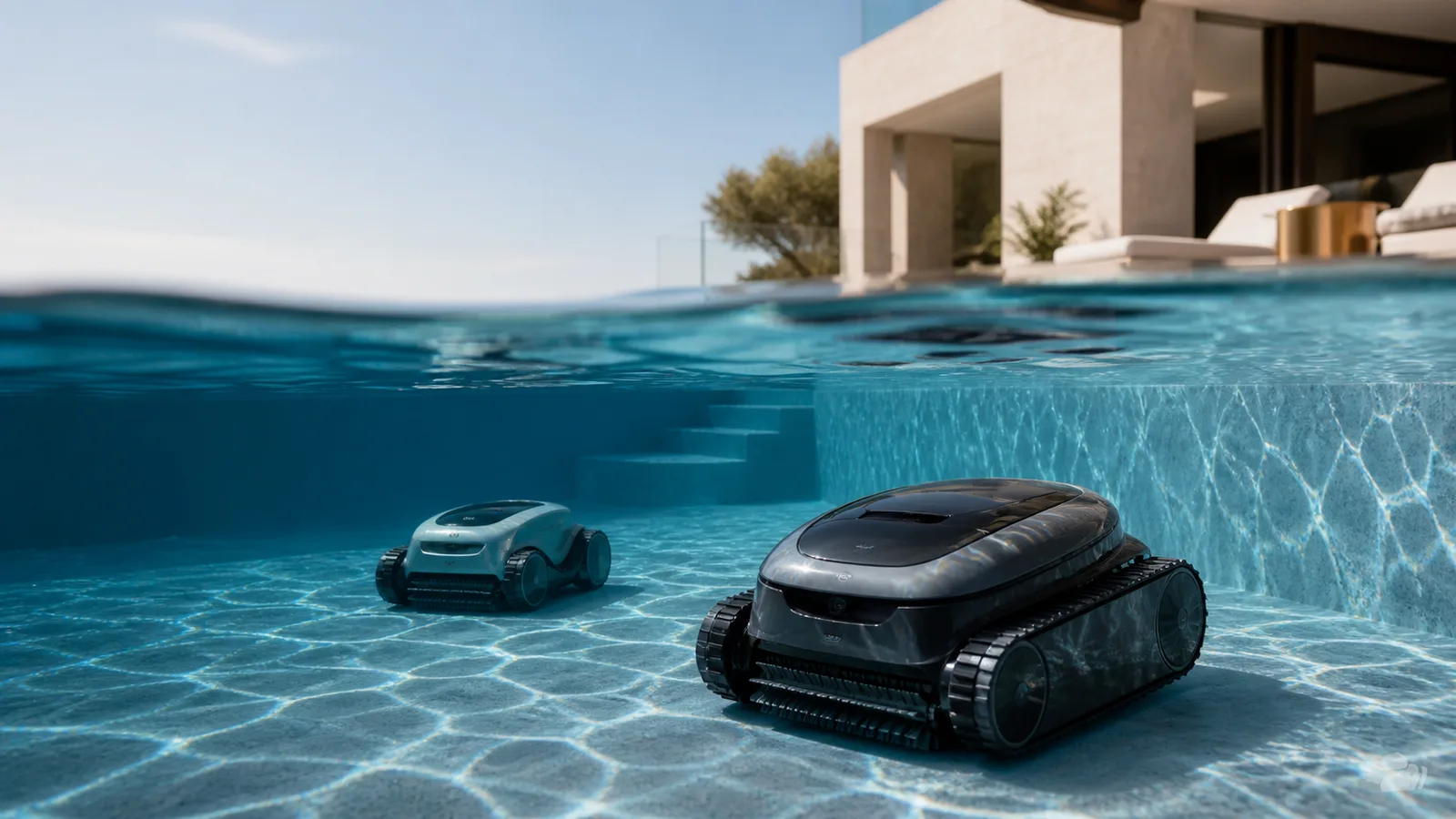
Aiper Scuba S1 vs Seagull Pro is no longer a normal feature comparison. Both are cordless robots designed for in-ground pools, but the Seagull Pro is an older recalled model while the Scuba S1 is the current platform with updated navigation, filtration options and app-related features.
This comparison now has a clear safety answer. On March 20, 2025, the U.S. Consumer Product Safety Commission announced a recall of Aiper Seagull Pro cordless robotic pool cleaners, model ZT6001, because the power adapter can overheat and create burn and fire hazards. Smart Poolside does not recommend buying or continuing to use the recalled model.
Aiper Scuba S1 vs Seagull Pro: safety-first comparison
| Feature | Aiper Scuba S1 | Aiper Seagull Pro |
|---|---|---|
| Model status | Current platform | Recalled in the United States (model ZT6001); stop use |
| Rated pool area | Up to 1,600 sq. ft. / 50 ft. | Up to about 1,600 sq. ft. / 50 ft. |
| Runtime | Up to 180 minutes on current US specification | Up to 150 minutes on current archived comparison |
| Drive | Caterpillar treads | Four-wheel drive |
| Navigation | WavePath 2.0 | Original WavePath |
| Filtration | 3.5L basket; 180-micron and replaceable 3-micron options listed | About 3.7L; 180-micron basket |
| Cleaning modes | Floor, wall, automatic, periodic/eco | Floor, wall, automatic |
| App | Current page lists app functions | No app on archived comparison |
Specifications differ across years, regions and retailer inventory. Check the product number and the manual supplied with the exact unit.
Why this comparison changed in 2026
Older reviews often portrayed the Seagull Pro as the larger, more powerful choice and the Scuba S1 as a smaller successor. That framing is misleading today. Aiper’s archived comparison lists both cleaners for roughly 1,600 square feet, with the Seagull Pro at up to 150 minutes and the current Scuba S1 at up to 180 minutes. The truly larger cordless models now sit higher in the Scuba line, such as the Scuba S1 Pro and Scuba X series.
The Seagull Pro’s 4,800 GPH figure is higher than the Scuba S1’s listed 4,200 GPH, but flow rate alone does not determine cleaning quality. Brush contact, path efficiency, filter loading, debris size and pool geometry all affect the result. Buying an older robot only because one number is larger can ignore support and filtration improvements that matter for years.
Navigation and mobility
The Scuba S1 uses WavePath 2.0, which Aiper describes as a system based on acceleration and inertial sensors plus programmed algorithms. It follows systematic patterns on the floor and walls to reduce repeated passes. Caterpillar treads provide a broad contact patch for slopes and wall transitions.
The Seagull Pro uses the earlier WavePath system and four-wheel drive. It follows S-shaped floor and N-shaped wall patterns and can clean floors, walls and the waterline transition. Its older navigation is not automatically ineffective, but it offers fewer reasons to prefer it when both models are similarly priced.
Winner: Scuba S1 for the newer navigation platform and tracked mobility.
Cleaning modes
The Seagull Pro provides three straightforward choices: floor, wall and automatic floor-plus-wall cleaning. That is enough for owners who want a simple dial-and-go routine.
The Scuba S1 adds periodic/eco behavior to its floor, wall and automatic modes. The periodic setting runs shorter maintenance cycles at scheduled intervals while the robot remains in the water for the supported period. It can be useful during a stable week, but it does not remove the need to inspect water chemistry, empty the basket and follow Aiper’s storage instructions.
Winner: Scuba S1 for flexibility; tie for basic one-cycle use.
Runtime and charging
Aiper’s current US Scuba S1 page lists up to 180 minutes of battery life and a three-to-four-hour charge. Earlier packages and regional pages may show 150 minutes, so confirm the exact version. The Seagull Pro comparison lists up to 150 minutes and a three-to-four-hour charge.
Maximum runtime is measured under defined conditions and should not be treated as a guarantee for every pool. Wall work, debris load, water temperature, software and battery age can shorten a cycle. More importantly, both robots must be retrieved and charged before another full cleaning. Owners who frequently need immediate repeat cycles may be happier with a corded cleaner.
Winner: Scuba S1 on the current maximum specification.
Filtration and debris
The Scuba S1 uses a 3.5-liter top-load basket. Aiper currently lists 180-micron filtration plus a replaceable 3-micron MicroMesh option. That fine element is relevant for dust, silt and pollen, although it will require careful rinsing and occasional replacement.
The Seagull Pro uses a slightly larger 3.7-liter top-load basket and a 180-micron filter on Aiper’s comparison. It can be capable with routine leaves and visible debris, but it lacks the newer model’s listed dual-level filtration flexibility.
Winner: Scuba S1 for fine-debris options; Seagull Pro has only a small basket-capacity advantage.
Do either of them scrub the waterline?
Both models can climb walls and reach the waterline area as part of their programmed route, but neither should be confused with Aiper’s newer horizontal-waterline systems. If persistent tile-line grime is the buying problem, compare the Scuba S1 Pro or Scuba X1, which explicitly list horizontal waterline movement.
This is a useful example of careful product language: “cleans the waterline” can mean briefly reaching the top of the wall, while “horizontal waterline cleaning” means moving laterally along that band. Confirm the exact behavior you need.
Recall, support and owner action
The Seagull Pro model ZT6001 is subject to a U.S. safety recall. The CPSC notice says the power adapter can overheat, creating burn and fire hazards. This is more important than any performance, discount or warranty comparison.
If you own one, stop using and charging it, identify the model number on the unit or documentation, and follow the official recall process. Do not sell or give away a recalled unit. If you are shopping for a cordless cleaner, choose a current non-recalled model that matches your pool size and surface.
Aiper Scuba S1: pros and cons
Aiper Seagull Pro: pros and cons
Which one should you buy?
Choose the Scuba S1 if:
- You are buying new at normal retail pricing.
- You want the current Aiper platform and app ecosystem.
- Fine dust or silt makes the MicroMesh option valuable.
- You prefer caterpillar treads and updated navigation.
- You want the longer current maximum runtime.
If you own a Seagull Pro:
- Stop using and charging the cleaner.
- Check whether the model is ZT6001.
- Follow the CPSC and Aiper recall instructions.
- Do not resell, donate or continue operating recalled inventory.
For current alternatives, see our best robotic pool cleaners guide and the detailed Dolphin CC Plus vs. Aiper Scuba S1 comparison.
Frequently asked questions
Is the Seagull Pro more powerful than the Scuba S1?
Its archived flow-rate specification is higher, but the safety recall makes performance comparisons secondary. Do not use or purchase recalled model ZT6001; follow the official remedy instead.
Which one is better for a 3,000-square-foot pool?
Neither. Official specifications place these models around 1,600 square feet. Look at a larger rated model, and confirm that its runtime and coverage match the actual shape and depth of the pool.
Can I leave either robot in the pool for a week?
Use only the periodic behavior described for the exact model and follow the manual. Even when a scheduled mode is supported, the basket still needs inspection and the robot should not remain submerged indefinitely.
Which one is easier to retrieve?
Both use a retrieval hook and quick-water-release design. Actual effort depends on where the robot parks, pool depth and the user’s ability to lift the wet unit as it drains.
Final verdict
The Aiper Scuba S1 is the only model recommended in this comparison for a new purchase in 2026, provided its current specifications fit your pool. The Seagull Pro model ZT6001 is recalled; owners should stop using it and follow the official CPSC/Aiper remedy. Smart Poolside has removed its purchase link.