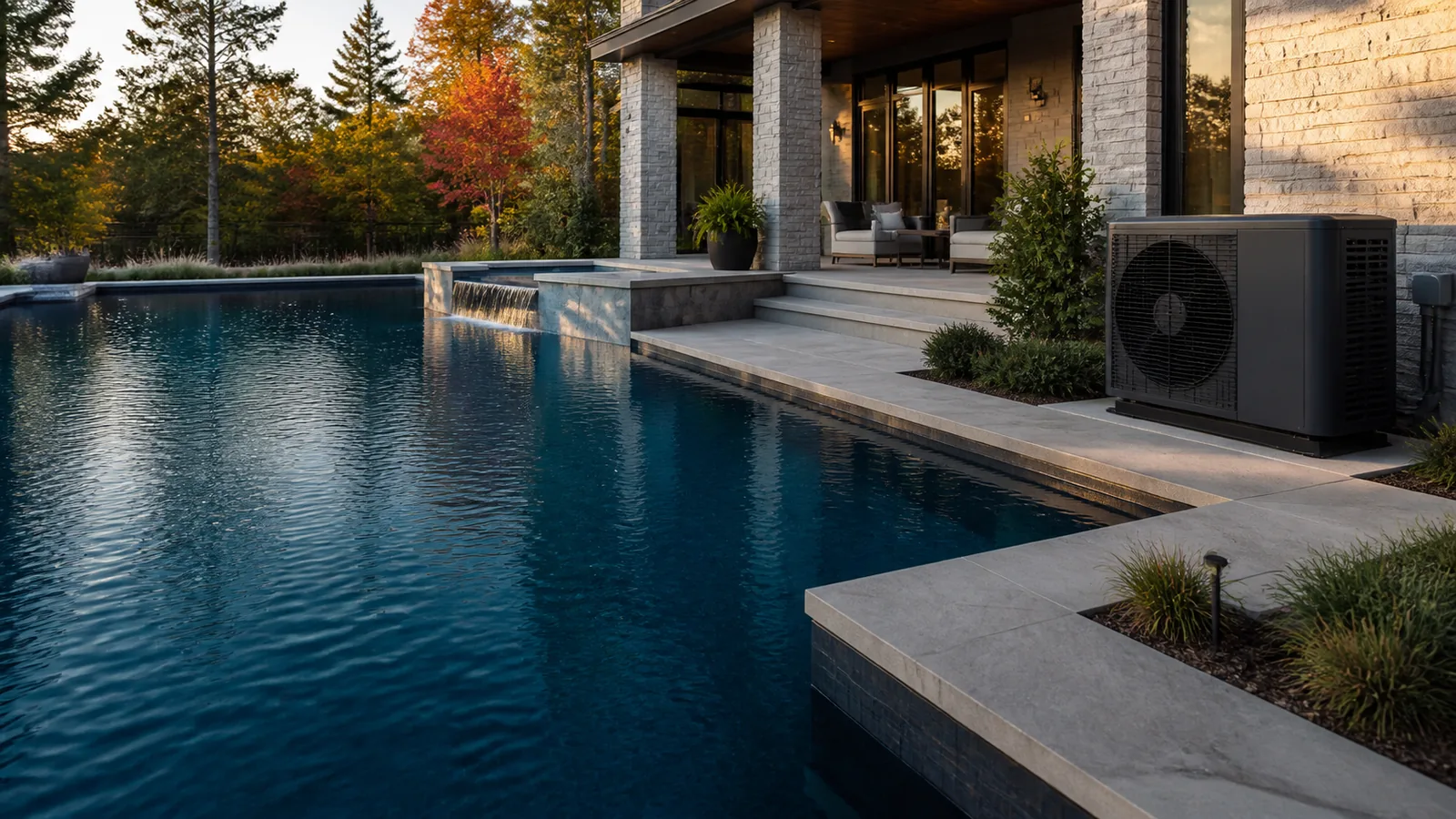
The best pool heat pump is not simply the model with the largest number on the brochure. It is the unit that can cover your pool’s surface area, target temperature and local weather without running at its limit all season. That is why this 2026 guide organizes three strong options by use case rather than declaring one universal winner.
For a large in-ground pool and broad dealer support, the current Hayward HeatPro Series is the premium mainstream choice. For a smaller pool and a tighter budget, the FibroPool FH255 is a compact 55,000-BTU option. For buyers who want inverter operation and heat/cool capability, the new AquaCal TropiCal line offers several sizes—but still needs professional sizing.
Quick comparison
| Pick | Current output range | Best fit | Electrical |
|---|---|---|---|
| Hayward HeatPro Series | 110,000–138,000 BTU at the warm-condition rating across cited models | Medium to large in-ground pools | 230V, dedicated circuit |
| FibroPool FH255 | 55,000 BTU | Above-ground pools and in-ground pools up to the maker’s 10,000-gallon guidance | 240V, dedicated circuit |
| AquaCal TropiCal T70/T100/T130 | 63,000–123,000 BTU at 80/80/80 boost rating | Owners who want inverter modulation and heat/cool operation | 230V, dedicated circuit |
Manufacturer ratings use specific air, water and humidity test points. The same unit produces less heat when outdoor air is colder. Do not size a heater by nominal BTU or pool gallons alone.
1. Best premium mainstream choice: Hayward HeatPro Series
Hayward’s current HeatPro microchannel range is the strongest fit when the pool is too large for compact value models. The cited series includes heat-only and heat/cool configurations. At the 80°F air, 80°F water and 80% relative-humidity rating, the current heat-only HP21105T, HP21205T and HP21405T are listed at 110,000, 120,000 and 138,000 BTU respectively. At a colder 50°F air rating, output is lower—exactly why the headline number cannot be used by itself.
The series uses a titanium-tube heat exchanger and 230V single-phase power. Published water-flow requirements and equipment clearances must be respected, and the largest model calls for a larger electrical circuit than the smaller units. A pool professional should match the exact model to the circulation system, breaker capacity, pad ventilation and local code.
Choose HeatPro when you have a mainstream in-ground installation, want high output and value access to a familiar service ecosystem. Skip it if your pool is small enough that a compact unit can meet the load or if the equipment pad cannot provide the required clearances.
2. Best value for smaller pools: FibroPool FH255
The FH255 is attractive because it does not force a small-pool owner to buy a six-figure-BTU machine. FibroPool lists 55,000 BTU of output, 240V power and suitability for in-ground pools up to 10,000 gallons, as well as specified above-ground sizes. The company’s sizing guide uses the FH255 as a starting point for a 10,000-gallon pool in moderate conditions.
That “up to” number is not permission to ignore climate. An uncovered 10,000-gallon pool in a windy northern location can require far more heating capacity than the same volume under a cover in a humid southern climate. Desired temperature and season length also matter. If you want warm water deep into spring and fall, ask for a heat-loss calculation and be prepared to size up.
Choose the FH255 when a qualified sizing calculation confirms the load, the compact cabinet suits your pad and you accept slower recovery than a larger model. It is not the value pick if it must run continuously and still cannot maintain the set point.
3. Best inverter line: AquaCal TropiCal
The redesigned TropiCal line uses inverter operation rather than simple full-on/full-off cycling. Current T70, T100 and T130 models are listed at 63,000, 108,000 and 123,000 BTU at the warm 80/80/80 boost condition. AquaCal also publishes much lower outputs at 50°F air: 25,500, 46,000 and 63,000 BTU. That transparent cold-condition table is one of the most useful specifications in the category.
Inverter modulation lets the unit reduce speed when the pool approaches its set point. AquaCal publishes high warm-condition Eco-mode COP figures, but those part-load numbers should not be compared directly with another brand’s full-load rating. The practical advantage is the ability to match output more closely to demand, not a promise of a fixed percentage savings for every pool.
Choose TropiCal when you value heat/cool operation, want a current inverter platform and can select the T70, T100 or T130 from an actual load calculation. The T70 is not automatically right for a “small” pool, and the T130 is not automatically right for every large one; climate and desired season decide.
How to size a pool heat pump correctly
Pool gallons affect warm-up time, but steady-state heat loss is driven heavily by surface area. Evaporation at the water surface is usually the biggest loss. A professional sizing calculation should include:
- pool surface area and volume;
- typical daytime and nighttime air temperature;
- humidity and wind exposure;
- desired water temperature;
- months of operation and required warm-up time;
- whether a fitted cover will be used consistently;
- spa spillovers, waterfalls and other evaporation-heavy features.
A cover can materially reduce evaporation and may change the required capacity or operating cost. The honest comparison is therefore not “Which brand has the highest COP?” but “Which correctly sized system can hold my target temperature in my design conditions?”
How to read BTU and COP ratings
BTU is heat output, not a constant
A heat pump moves heat from outdoor air into the pool. As the air gets colder and drier, less heat is available and the unit’s output falls. Always compare models at the same published air, water and humidity test point. A 120,000-BTU warm-weather rating does not mean the unit produces 120,000 BTU on a cold spring morning.
COP depends on the test condition
Coefficient of performance describes heat delivered relative to electrical energy consumed at a stated condition. A COP of 5 means five units of heat output for one unit of electrical input at that test point. It does not mean a universal five-to-one dollar return, because electricity rates, weather, pump runtime and heat loss vary.
Installation costs buyers forget
- Electrical: These units generally need a dedicated high-voltage circuit, disconnect and code-compliant bonding by a qualified professional.
- Plumbing: Correct flow, unions and sometimes a bypass are required. Too little or too much flow can reduce performance or damage equipment.
- Pad and airflow: Heat pumps move large volumes of air. Tight walls, roofs or landscaping can recirculate cold exhaust and hurt output.
- Condensate: Water dripping under an operating heat pump can be normal condensation, but the pad still needs drainage.
- Winterization: Freeze protection and draining requirements depend on the model and climate. Follow the exact manual.
Heat pump or gas heater?
A heat pump is usually strongest when the goal is efficient temperature maintenance over many days in mild-to-warm air. A gas heater is often stronger for rapid spa heating, short-notice warm-up or cold-weather output. Some premium pools use both: a heat pump for baseline temperature and gas for fast recovery. The right answer depends on fuel prices, electrical capacity, climate and how spontaneously you swim.
Frequently asked questions
How many BTUs do I need for a 10,000-gallon pool?
Volume alone is not enough. Surface area, climate, target temperature, wind, cover use and season length determine the load. The FH255 may suit a covered 10,000-gallon pool in moderate conditions, while a colder or exposed installation may require a much larger unit.
Can a pool heat pump work below 50°F?
Some current models are designed to operate in cooler air, but output and efficiency fall as air temperature drops and defrost behavior becomes relevant. Check the exact operating range and the manufacturer’s output at a cold test condition.
Are heat pumps compatible with saltwater pools?
Many current pool heat pumps use titanium heat exchangers intended for modern pool-water systems, but compatibility does not eliminate the need to keep chemistry within the manufacturer’s limits. Verify the manual and warranty terms for the exact model.
Should I buy the biggest unit I can afford?
Not automatically. More capacity can improve recovery, but it also raises purchase cost, electrical requirements and space needs. Inverter models can modulate, yet the system still needs a proper minimum and maximum fit for the pool.
Final verdict
Choose the Hayward HeatPro Series for a high-capacity mainstream in-ground installation, the FibroPool FH255 for a smaller pool whose calculated load fits 55,000 BTU, and the AquaCal TropiCal line when inverter heat/cool operation is worth the premium. Before clicking “check price,” spend money on the sizing decision: the correctly sized midrange model will outperform an impressive-looking unit chosen from gallons and marketing copy alone.