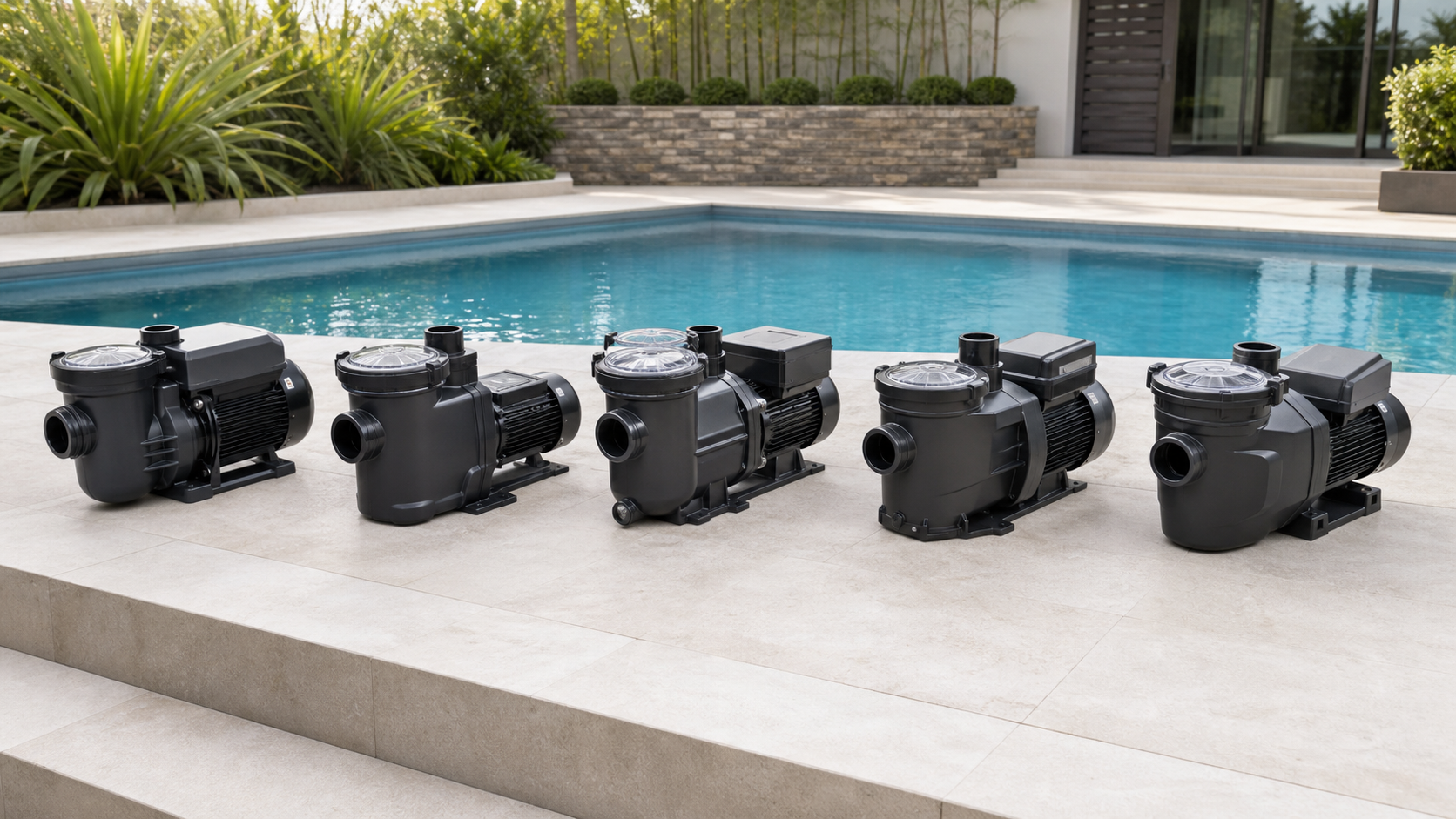
A variable-speed pool pump saves energy only when it is sized and programmed for the real hydraulic system. Buying the highest horsepower and running it near maximum speed simply recreates the operating cost and noise of the pump it replaced.
For this 2026 guide, Smart Poolside compared current US manufacturer specifications, Weighted Energy Factor (WEF), voltage flexibility, plumbing connections, automation options and replacement fit. We selected five pumps for different projects rather than pretending that one wet end suits every pool.
Affiliate disclosure: As an Amazon Associate, we earn from qualifying purchases. If you buy through links on this page, Smart Poolside may earn a commission at no extra cost to you. Recommendations remain editorially independent.
Best variable-speed pool pumps: quick picks
| Pump | Best for | Key official specification | Main caution |
|---|---|---|---|
| Pentair IntelliFlo3 VSF 3.0 HP | Best overall smart/high-capacity pump | 3.0 THP, WEF 7.1, 208–230 V | More pump than many simple pools need |
| Hayward TriStar VS 900 | Best efficiency-focused full-size replacement | 1.85 THP, WEF 12.9/8.3, dual voltage | Verify WEF at the installed voltage |
| Jandy VS FloPro 2.7 HP DV2A | Best Jandy retrofit with accessory control | Dual voltage and two auxiliary relays | App control requires compatible Jandy interface |
| Pentair SuperFlo VST | Best practical standard-pool replacement | 2.2 THP, WEF 9.0 at 230 V, RS-485 | Not intended for the most demanding feature systems |
| Hayward TriStar VS 950 | Best higher-output Hayward option | 2.70 THP, WEF 10.1/7.3, 600–3450 RPM | Needs correct plumbing and system curve |
Specifications were checked against manufacturer pages and brochures on August 26, 2026. WEF can differ by voltage and model. Confirm the exact part number and current certification before purchase.
How we evaluated the pumps
- Hydraulic fit: the pump must meet required flow at the system’s total dynamic head.
- WEF: gallons moved per watt-hour under the applicable DOE test procedure; higher is more efficient within a meaningful comparison.
- Voltage and plumbing: a “drop-in” claim does not eliminate electrical and dimensional checks.
- Control: local schedules, RS-485, manufacturer automation and app requirements.
- Serviceability: basket access, unions, replacement parts and local support.
Horsepower is not a flow guarantee. Pipe size, elevation, filter condition, heater, valves and fittings determine the system curve.
1. Pentair IntelliFlo3 VSF 3.0 HP: best overall
The IntelliFlo3 VSF combines variable speed with sensorless flow control. Pentair says the pump can adjust speed to maintain a selected flow as system resistance changes, which can be useful when valves move or a filter loads. App control is built in, while an optional touchscreen provides local operation.
The 3.0 HP versions carry a WEF of 7.1 and operate at 208–230 volts. Pentair offers 2-, 2.5- and optional 3-inch connection arrangements. That flexibility does not justify undersized suction plumbing; the installer must still respect velocity, suction-outlet and equipment requirements.
Choose IntelliFlo3 when advanced Pentair control, high feature flow or sensorless flow regulation adds real value. For a basic pool, the 1.5 HP IntelliFlo3 or a smaller replacement pump may be more efficient financially.
2. Hayward TriStar VS 900: best efficiency-focused choice
Hayward’s TriStar VS 900 is the efficiency standout in this group. Official literature lists 1.85 total horsepower, a 600–3450 RPM range and WEF values of 12.9/8.3 depending on voltage. That does not mean it will use the least energy in every pool; sizing and schedule remain decisive.
The pump supports 115- or 230-volt applications and uses 2 x 2.5-inch union connections. A VS Omni bundle adds a control pad and broader equipment connections, while the pump-only version can integrate with compatible Hayward automation. Confirm exactly which package is being quoted.
Choose the VS 900 when the hydraulic demand fits its performance curve and you do not need the added output of the VS 950.
3. Jandy VS FloPro 2.7 HP DV2A: best Jandy retrofit
VS FloPro is engineered around retrofit flexibility. Jandy describes the 2.7 HP DV2A model as dual voltage with two auxiliary relays, allowing a compatible controller to operate the pump plus selected additional loads such as a booster pump or salt system.
The compact body and replacement-base options can reduce plumbing changes, but “drop-in” is never automatic. Measure suction and discharge centerlines, available service clearance and pipe condition. App control depends on iQPUMP01 or compatible AquaLink equipment; the pump alone is not a complete internet controller.
Choose VS FloPro when the pool already uses Jandy automation or when its physical replacement fit prevents expensive plumbing reconstruction.
4. Pentair SuperFlo VST: best practical standard-pool replacement
SuperFlo VST focuses on practical replacement. Pentair lists 2.2 THP, WEF 9.0 at 230 volts and WEF 7.3 at 115 volts. The onboard keypad provides three programmable speeds, an override and a real-time clock. RS-485 supports compatible automation.
Pentair positions it as a replacement for its SuperFlo and Hayward Super Pump footprints, for pools previously requiring up to about a 1.5 HP pump. That historical label is only a starting point; total horsepower, service factor and the new pump’s performance curve must be compared.
Choose SuperFlo VST when simple local scheduling and a familiar replacement footprint matter more than built-in Wi-Fi or flow control.
5. Hayward TriStar VS 950: best higher-output Hayward option
The VS 950 moves up to 2.70 total horsepower while retaining dual-voltage flexibility and the 600–3450 RPM range. Hayward publishes WEF values of 10.1/7.3 depending on voltage. It is a better match than the VS 900 when spa jets, waterfalls or other simultaneous loads require more head and flow.
Oversizing still has costs: higher purchase price, larger available power and the temptation to mask restrictive plumbing with RPM. Ask for a duty-point calculation rather than a horsepower-only recommendation.
How to size a variable-speed pump
- List every operating mode: filtration, heating, spa, cleaner and water features.
- Determine required flow for each device and safe pipe velocities.
- Estimate or measure total dynamic head at those flows.
- Plot the duty points against the manufacturer’s performance curves.
- Check voltage, breaker, conductor, bonding and communication requirements.
- Select the smallest pump that meets the highest legitimate duty point with margin.
Then build a low-speed filtration schedule and short higher-speed windows for skimming, heating or features. Our pool-pump runtime guide explains why runtime and speed must be considered together.
WEF and energy-savings claims
The US Department of Energy uses WEF as the efficiency metric for dedicated-purpose pool pumps. It represents gallons moved per watt-hour under a standardized test. It is more useful than horsepower for comparing efficiency, but only among pumps appropriate for the same hydraulic job.
Manufacturer claims of “up to” 80% or 90% savings compare particular variable-speed schedules with stated single-speed assumptions. Your savings depend on electricity price, old pump, plumbing, speed and daily runtime. Request a calculation using your utility rate and proposed schedule.
Installation checklist
- Use a qualified installer and licensed electrician where required.
- Verify suction-outlet and entrapment-protection compliance.
- Do not reduce pipe size merely to fit old plumbing.
- Provide required straight pipe, clearance and drainage.
- Confirm bonding, grounding, breaker and GFCI requirements.
- Program freeze protection and heater minimum flow correctly.
- Record the final speeds, watts and filter pressure in every operating mode.
Frequently asked questions
Is a higher-HP variable-speed pump more efficient?
Not automatically. A larger pump may run a required flow at a lower RPM, but it also costs more and can exceed plumbing or equipment limits. Compare WEF and the duty point, not horsepower alone.
Should a variable-speed pump run 24 hours?
It can, but it does not always need to. The optimum schedule depends on sanitation, skimming, heating and local conditions. Measure water quality and energy rather than copying a universal schedule.
Can a 115-volt pump be replaced with a 230-volt model?
Only after a qualified electrician verifies the circuit and local code. Some pumps auto-sense multiple voltages; others are limited to 208–230 volts.
Do I need app control?
No. A reliable local schedule is sufficient for many pools. App access is valuable for remote changes and alerts, but it should not replace safe local operation.
What does WEF mean?
Weighted Energy Factor is the DOE efficiency metric expressed in gallons per watt-hour under the prescribed test. Higher is more efficient, but only after confirming that the pump can perform the required hydraulic work.
Final verdict
IntelliFlo3 VSF 3.0 HP is the best overall smart, high-capacity pick. TriStar VS 900 delivers the strongest efficiency-focused specification for many standard installations. VS FloPro 2.7 HP is the retrofit-friendly Jandy choice, SuperFlo VST is the practical standard-pool replacement, and TriStar VS 950 covers higher Hayward demand.