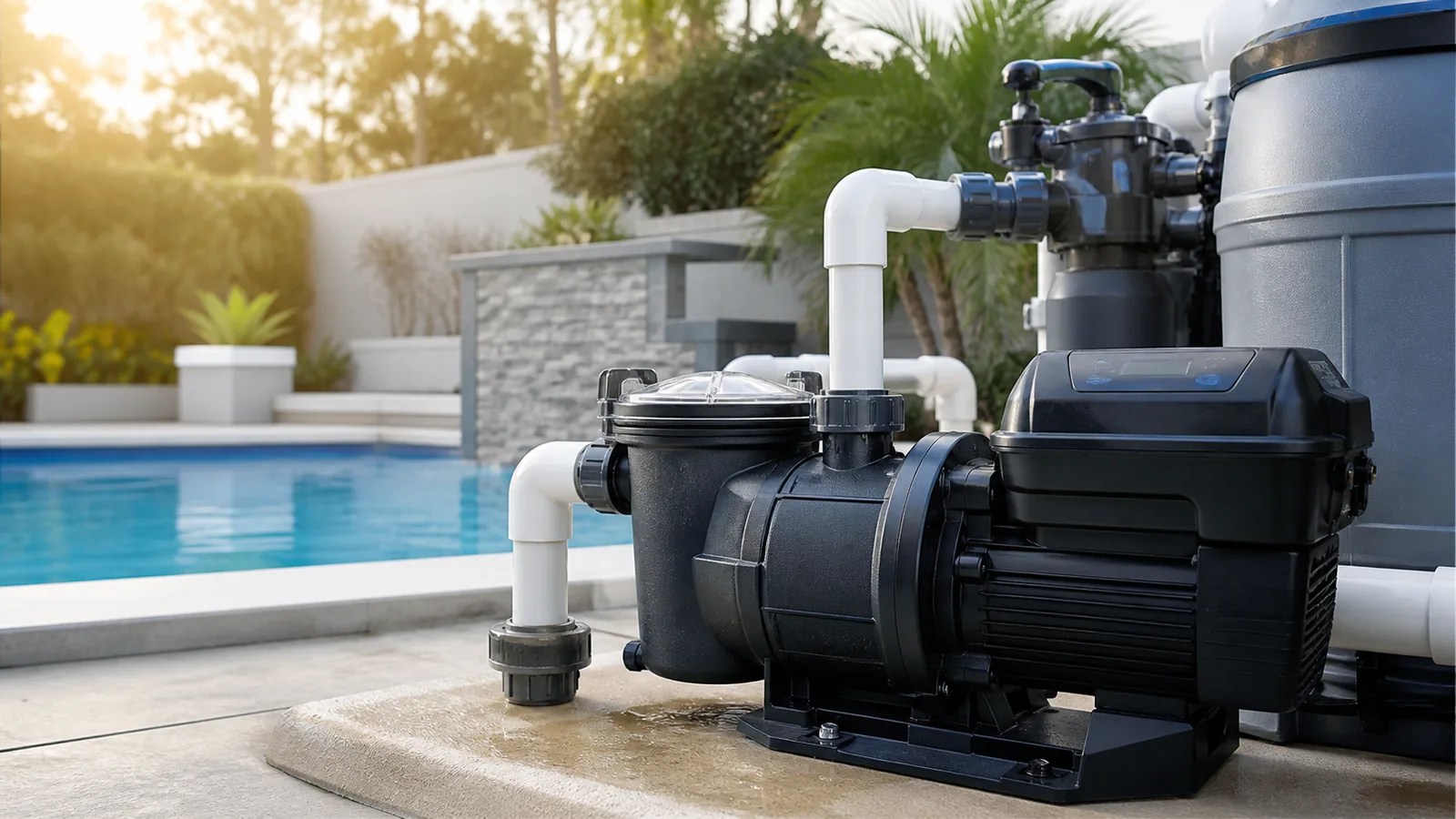
There is no universal eight-hour rule for every swimming pool. The right pool-pump schedule depends on the water volume, the pump’s actual flow at the selected speed, filter condition, sanitizer system, weather and swimmer load. A variable-speed pump may run longer at low speed while using less electricity than a single-speed pump running for a shorter period.
This guide shows how to set a safe starting schedule, test whether it is working and adjust it without guessing. It is based on current ENERGY STAR and US Department of Energy guidance, CDC water-quality recommendations and manufacturer operating principles.
How long should you run your pool pump?
| Pool condition | Practical starting point | What to verify |
|---|---|---|
| Variable-speed pump, normal residential use | Longer low-speed filtration window, often split around chlorine production and debris collection | Stable sanitizer, clear water, adequate skimming and minimum equipment flow |
| Single-speed pump | Shortest continuous schedule that maintains clarity and sanitation | Daily test results and complete surface skimming |
| Saltwater pool | Long enough for the salt chlorine generator to meet daily chlorine demand | Free chlorine—not the cell percentage alone |
| After heavy rain or a pool party | Temporarily extend circulation and filtration | Chlorine, pH, clarity and filter pressure |
| Cold or closed-season water | Follow the equipment and winterization plan | Freeze protection and manufacturer limits |
A clock setting is only a starting point. Two pools with the same gallonage can need different schedules because pipe resistance, filter loading, pump speed and sunlight change the result.
Why “one turnover” is not a complete answer
Turnover means moving a volume of water equal to the pool volume through the circulation system. The simplified calculation is:
Runtime in minutes = pool volume in gallons ÷ measured flow in gallons per minute.
For example, a 15,000-gallon pool at a verified 40 gallons per minute would require 375 minutes, or 6.25 hours, to move one pool volume. This does not mean every molecule passes through the filter, and it does not prove that chlorine is adequate or that dead zones are circulating well.
Flow should be measured or obtained from reliable system data. Dividing by a pump’s advertised maximum flow can badly underestimate runtime because the installed plumbing, filter, valves, heater and elevation add resistance.
Why variable-speed pumps often run longer
ENERGY STAR explains that filtration generally needs less flow than demanding functions such as a pressure-side cleaner. A variable-speed pump can match speed to the job instead of running every task at maximum output. Slower filtration can also reduce strain on plumbing and filters.
The US Department of Energy’s pump guidance describes the affinity-law relationship: reducing motor speed reduces flow, while power demand falls much faster. The exact savings depend on the installed system, so do not copy another owner’s RPM setting as if it were a universal flow rate.
A useful three-stage schedule
- Short higher-speed period: prime the system, improve surface skimming or operate equipment that requires more flow.
- Long low-speed period: provide steady filtration and, where applicable, salt-cell production.
- Optional cleanup period: add circulation after swimming, wind, rain or chemical treatment when the product label calls for it.
Confirm that the flow switch on the heater or salt cell remains satisfied at low speed. A schedule that saves electricity but disables sanitation is not successful.
How to set your pump schedule in six steps
1. Calculate the real pool volume
Use measured dimensions and average depth, not the marketing size of the shell. Include attached spa spillover only when it shares the circulating water. An inaccurate volume also leads to inaccurate chemical doses.
2. Identify minimum equipment flow
Check manuals for the pump, filter, heater, salt chlorine generator, solar system and any pressure-side cleaner. Use the highest required minimum for devices that operate together. If heating is part of the schedule, compare equipment requirements in our pool heat pump guide.
3. Establish a conservative baseline
Begin with the installer’s documented schedule or a full normal-day operating window. Keep other variables stable for several days rather than changing runtime, chlorine output and chemical targets simultaneously.
4. Test chlorine and pH
CDC identifies disinfectant and pH as the first defense against waterborne germs. It recommends pH 7.0–7.8 and at least 1 ppm free chlorine in pools, or at least 2 ppm when cyanuric acid or stabilized chlorine is used. Follow the sanitizer label and local requirements where they are more restrictive.
5. Observe clarity, skimming and pressure
Look across the longest dimension of the pool toward a drain or fitting. Note surface debris, haziness and the filter’s clean-pressure baseline. A dirty filter can reduce flow even though the timer has not changed.
6. Adjust gradually
Change the daily window in small increments, then monitor for several comparable days. Restore runtime promptly if free chlorine falls, water loses clarity or surface debris accumulates.
When the pump needs more runtime
- Hot, sunny weather: chlorine demand and algae risk usually rise.
- Heavy swimmer load: sweat, dirt and other contaminants consume sanitizer.
- Rain and wind: the pool receives debris and dilution.
- Salt-cell production: a generator only produces chlorine while it has power and adequate flow.
- Active cleanup: suspended algae or fine debris needs sustained filtration after correct treatment.
- Water features: spillovers and fountains may require scheduled circulation for water quality.
Runtime is not a substitute for chemistry. If the pool repeatedly loses chlorine, investigate sanitizer output, cyanuric acid, contamination, cell condition and test accuracy instead of running the pump indefinitely.
Should the pump run during the day or at night?
Daytime operation supports skimming while leaves and insects are landing and can align salt-cell production with solar chlorine loss. Night operation may benefit from off-peak electricity pricing. Many pools work best with a split schedule.
Prioritize sanitation and equipment compatibility over a blanket day-versus-night rule. If your utility uses time-of-use rates, place high-speed tasks outside the most expensive period when practical, but maintain enough daytime circulation to keep the surface and sanitizer stable.
Common scheduling mistakes
- Using advertised maximum pump flow in the turnover calculation.
- Reducing RPM below a salt cell’s or heater’s flow requirement.
- Ignoring a rising filter-pressure reading.
- Assuming clear water proves adequate disinfection.
- Running at maximum speed for filtration that could occur efficiently at lower speed.
- Changing the schedule immediately after every single test result.
Frequently asked questions
Is eight hours a day enough for a pool pump?
It may be too much, too little or appropriate. Confirm actual flow, sanitizer level, clarity and equipment requirements. Hours alone do not describe circulation performance.
Can I run a variable-speed pump 24 hours a day?
Some systems are designed for extended low-speed operation, but continuous runtime is not automatically necessary. Compare measured water quality and electricity use, and follow the pump and connected-equipment manuals.
Does the pump need to run when adding chlorine?
Follow the chemical label. Circulation is normally required to distribute pool chemicals safely, but products differ in application method and required waiting time.
How do I know the flow rate?
Use an installed flow meter, compatible automation data or a hydraulic assessment. A pump’s RPM is not a universal flow measurement because plumbing resistance varies.
Should I run the pump during freezing weather?
Follow the equipment manufacturer’s freeze-protection and winterization instructions. Freeze protection reduces risk but does not replace correct winterization in climates with sustained freezing.
Final recommendation
Set pump runtime from measured performance, not a fixed internet rule. Start conservatively, use the lowest speed that reliably supports the equipment, and adjust with free-chlorine tests, pH, clarity, skimming and filter condition. A variable-speed pump usually earns its advantage by matching speed to each task rather than compressing every task into a short high-speed window.