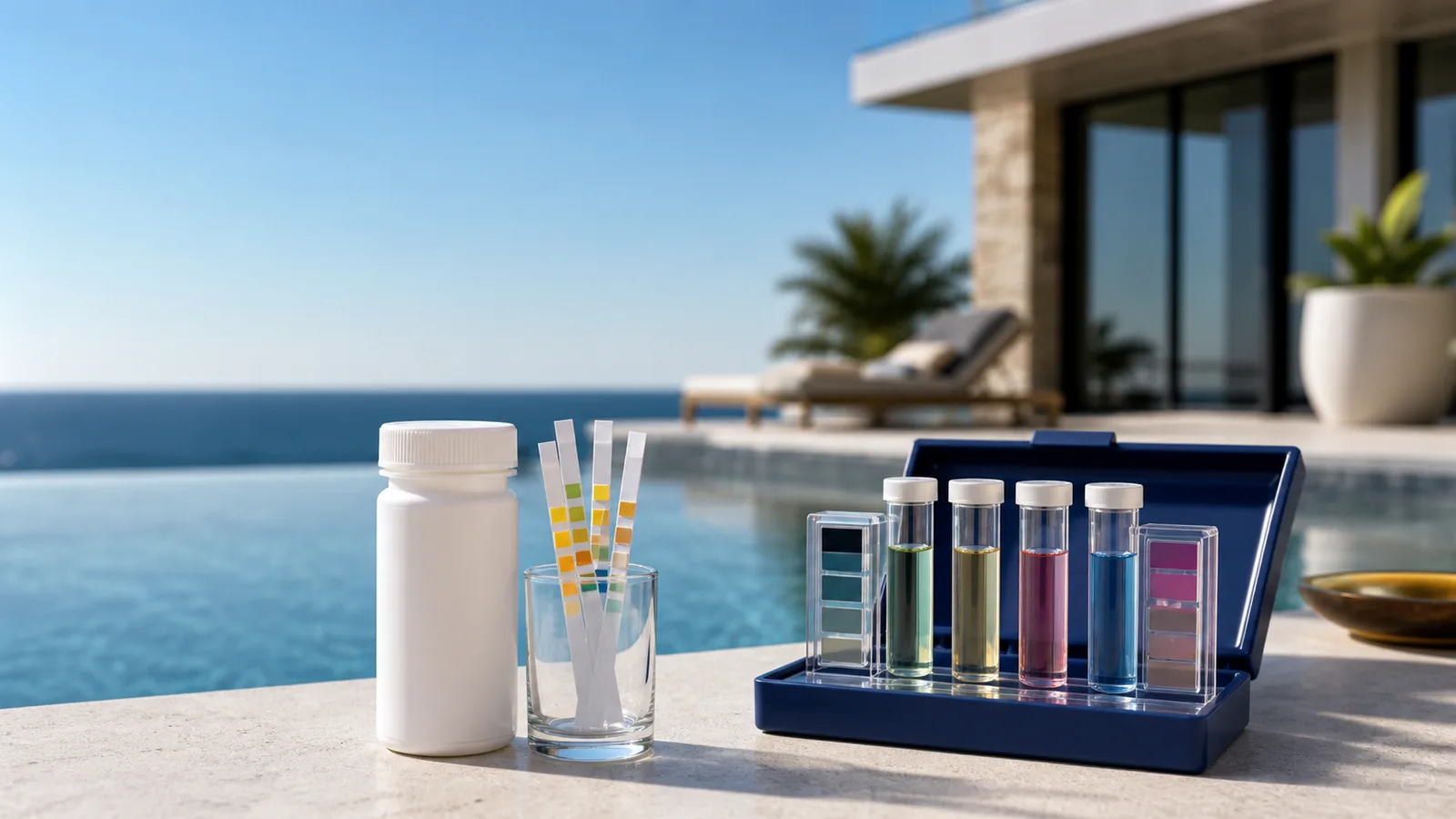
Pool test kits fall into two practical groups. Comparing pool test strips vs liquid test kits is not simply a convenience contest. Strips are fast enough for a routine screen before a swim, while a good liquid kit is better when the result will determine how much chlorine, acid or alkalinity increaser goes into thousands of gallons of water.
The most practical setup for many owners is not “strips or drops.” It is strips for quick trend checks and a complete drop kit for dosing, troubleshooting and confirmation.
Pool test kits: strips vs liquid at a glance
| Factor | Test strips | Liquid drop kit |
|---|---|---|
| Speed | Very fast | Several minutes for a full panel |
| Learning curve | Low | Moderate |
| Result detail | Broad color ranges | Defined comparator or titration increments |
| Best use | Routine screen and trend check | Dosing, diagnosis and opening/closing |
| Main weakness | Color interpretation and limited resolution | Technique, time and reagent care |
If a result leads you to raise alkalinity, use our test-first baking soda guide. If the water is visibly hazy, diagnose it with the cloudy-pool recovery checklist rather than dosing from appearance alone.
Which method is more accurate?
Among pool test kits, the clearest authoritative guidance comes from the CDC’s home pool testing recommendations: it advises a DPD test kit for the most accurate chlorine and pH results and notes that test strips are less accurate. That distinction matters when a broad strip color block could change a chemical dose.
A result is only as good as the method and technique. An expired liquid reagent, sideways dropper bottle, contaminated sample tube or color-blind comparator reading can be less useful than a fresh, correctly handled strip. “Liquid” does not automatically mean “correct.”
When test strips make sense
- A quick chlorine and pH screen before swimmers enter.
- Checking whether readings are trending up or down between full tests.
- Travel, vacation homes and simple above-ground pools where portability matters.
- A second opinion that tells you when to bring out the full kit.
Use strips from a reputable water-testing manufacturer, close the cap immediately and keep wet fingers out of the bottle. Follow the specified dip time and reading time; colors can continue changing if you wait too long.
For readers who want a convenient multi-parameter option, the VARIFY 7-in-1 strips check total hardness, free and total chlorine, bromine, pH, total alkalinity and cyanuric acid. Treat the color blocks as screening ranges rather than laboratory-grade dosing measurements.
When a liquid kit is worth it
A complete liquid kit is the better choice when you are opening a pool, fighting algae, adjusting alkalinity, diagnosing scale or calculating a sanitizer dose. It separates tests into defined procedures and provides more resolution.
For chlorine, distinguish two common methods:
- DPD color matching: the sample develops a pink color that is compared with a printed scale. Fast, but very high sanitizer can bleach the sample and create a false-low result.
- FAS-DPD titration: powder turns the sample pink and drops are counted until it becomes colorless. It measures free and combined chlorine with useful precision across a wider range, making it especially valuable during algae treatment.
A complete residential kit should cover free/combined chlorine, pH, total alkalinity, calcium hardness and cyanuric acid. Salt-pool owners may add a chloride/salt test, although the cell’s display remains useful for trend monitoring.
How to choose pool test kits
Chlorine pools
Choose a kit that measures free and combined chlorine separately, not only total chlorine. Include pH, alkalinity, calcium hardness and CYA for a plaster, fiberglass or vinyl outdoor pool.
Saltwater pools
A saltwater pool is still a chlorine pool. It needs the same core panel plus a salt test compatible with the generator’s range. Do not rely only on the control panel: it may estimate salt indirectly and can drift with temperature or cell condition.
Spas and hot tubs
Use a test range designed for the higher sanitizer levels and hotter water. CDC recommends at least 3 ppm chlorine in hot tubs and advises against cyanuric acid or stabilized chlorine products in hot tubs.
How to get more reliable results
- Collect water away from a return jet, chemical feeder and skimmer.
- Take the sample from elbow depth rather than the surface film.
- Rinse the cell with pool water before testing.
- Follow the exact sample volume and reagent order.
- Hold dropper bottles vertically for uniform drops.
- Read color tests in neutral daylight against the specified background.
- Do not interchange reagents or comparator blocks from different systems.
- Record the results so trends become visible.
How to store pool test kits
Heat and moisture damage both strips and reagents. Do not store the kit in a hot pump room or outside deck box. Keep caps tight, protect reagents from freezing and replace products at their printed expiration or “best by” date. Taylor advises that its reagents and strips require controlled storage conditions.
How often should you test?
CDC recommends routine chlorine and pH testing. The appropriate home schedule depends on weather, swimmer load and the stability of the pool. Test more often during heat, storms, parties, algae treatment and equipment problems. Slower-moving parameters such as calcium hardness and CYA usually need less frequent checks, but they should be confirmed before large water-balance decisions.
Frequently asked questions
Are digital pool test kits better?
A good meter can reduce color-matching ambiguity, but it requires calibration, clean sensors and replacement standards. Check the manufacturer’s stated accuracy and maintenance requirements.
Why does my pool-store result differ from my home kit?
Sampling time, transport, reagent condition, calibration and method can all differ. Repeat the home test carefully with fresh reagents and compare samples taken at the same time.
Can I use test strips to calculate a chemical dose?
For a small correction, a strip may be sufficient. Confirm large or safety-critical adjustments with a higher-resolution drop test.
Final verdict on pool test kits
Test strips win on speed; liquid drop kits win on decision quality. A quality FAS-DPD kit is the most useful primary tool for an owner who manages chemistry, while fresh strips are an excellent supplement for quick checks. The best kit is the one you can use correctly, store properly and replace on schedule.
Closing for winter? Use our 12-step pool closing checklist after testing and balancing the water.