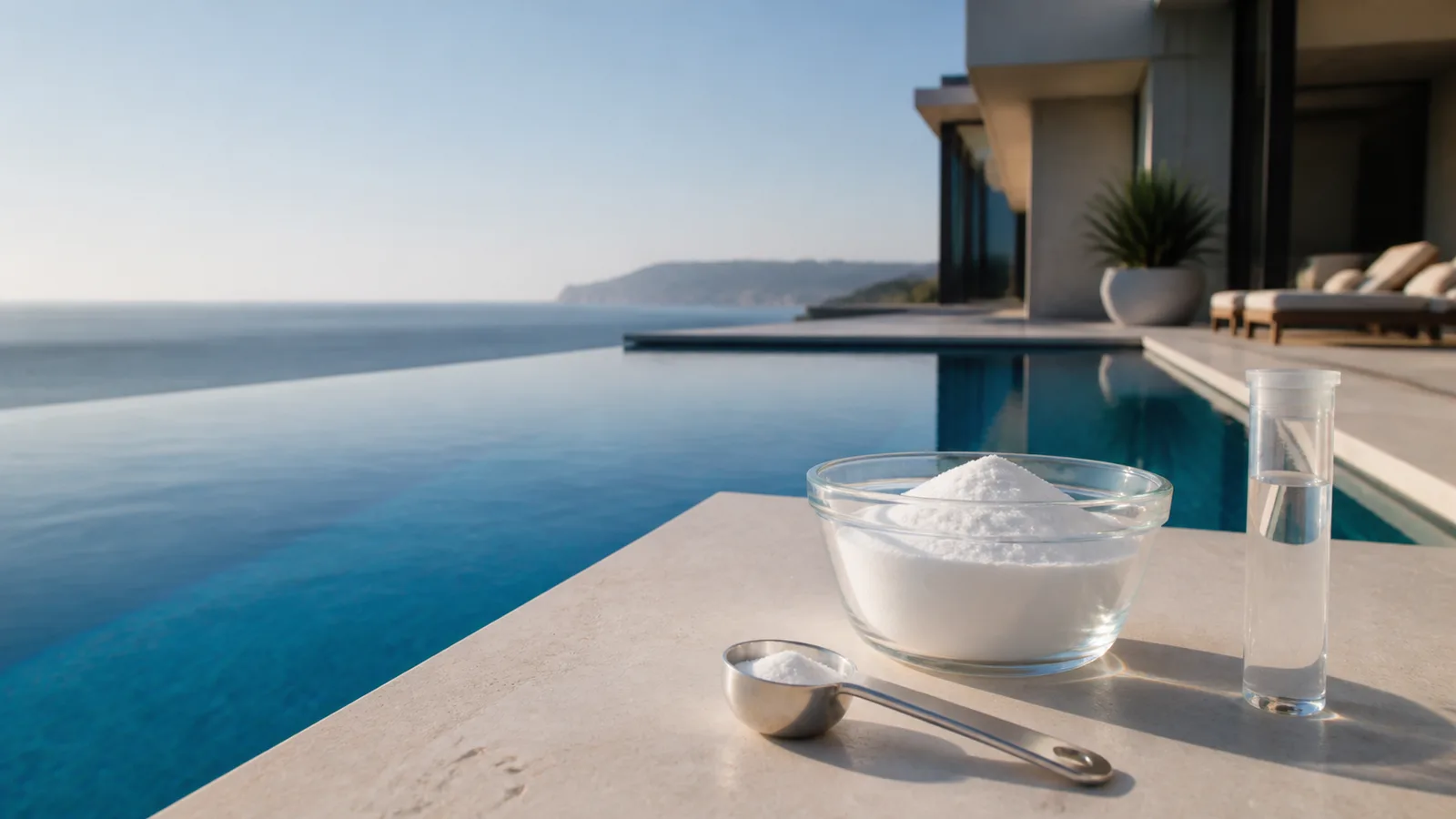
Baking soda in pools can be useful because its active ingredient—sodium bicarbonate—is also the basis of many products sold as alkalinity increaser. It raises total alkalinity with a comparatively modest effect on pH.
Using baking soda in pools is not complete advice by itself. It should be added only after an alkalinity test, in a dose calculated for the pool’s actual volume and current reading. It will not sanitize water, remove algae or efficiently correct a very low pH by itself.
What baking soda in pools actually does
Taylor Technologies explains that total alkalinity is the water’s ability to buffer changes in pH. When alkalinity is too low, pH can swing rapidly and water may become more corrosive. Sodium bicarbonate adds bicarbonate alkalinity, making pH more stable.
Taylor’s residential guidance uses 80–120 ppm as a common total alkalinity range. The ideal target for a specific pool can vary with sanitizer type, aeration, surface and professional water-balance method. Treat a single range as a starting point, not a substitute for the equipment and chemical manufacturers’ instructions.
What baking soda does not do
- It does not disinfect the pool. Sodium bicarbonate is not chlorine or bromine.
- It does not kill algae. Green water needs sanitizer, brushing, filtration and a cause-based treatment plan.
- It is not the fastest pH increaser. Soda ash raises pH more strongly, although it also affects alkalinity.
- It does not automatically clear cloudy water. Adding it when alkalinity is already high can increase scaling and clouding risk. Use a cause-based cloudy-pool recovery process instead.
- It cannot replace testing. pH alone does not reveal total alkalinity. Our test strips vs. liquid test kits comparison explains the accuracy tradeoffs.
Baking soda vs. “Alkalinity Up”
| Question | Baking soda | Pool alkalinity increaser |
|---|---|---|
| Common active ingredient | Sodium bicarbonate | Usually sodium bicarbonate |
| What to verify | Ingredient purity and no additives | Active ingredient and concentration |
| Dosing directions | May not include pool-specific instructions | Usually includes pool dosing table |
| Best value | Often lower cost per pound | Can be convenient when directions/support matter |
Do not use a scented, blended or cleaning product just because “baking soda” appears in the name. The package should identify sodium bicarbonate without fragrances, detergents or unrelated additives.
How much baking soda in pools is appropriate?
Taylor Technologies’ alkalinity dosage chart gives a useful approximation: about 1.4 pounds of sodium bicarbonate per 10,000 gallons raises total alkalinity by roughly 10 ppm. That is planning math, not permission to ignore the product label. Real pool volume estimates and test uncertainty can materially change the result.
A simplified estimate is:
Pounds needed ≈ 1.4 × (pool gallons ÷ 10,000) × (desired alkalinity increase ÷ 10)
Example: a correctly measured 15,000-gallon pool moving from 60 ppm to 80 ppm needs an estimated 4.2 pounds. Add less than the full estimate initially, circulate and retest. It is easier to add a little more than to reverse an overshoot.
How to add baking soda safely
- Measure first. Use a current total alkalinity and pH result from a reliable test kit.
- Confirm pool volume. Do not rely on a rough real-estate listing or builder label when the shape is irregular.
- Calculate a conservative dose. Use the product directions or a calculator for the exact concentration.
- Read the label. Wear the listed protective equipment and follow its addition method. Do not pre-dissolve unless directed.
- Run circulation. Add the product to the pool water as directed, away from swimmers and concentrated chemical residue.
- Brush any settled material. Help it disperse rather than remaining in one spot.
- Wait and retest. Follow the label’s circulation interval before measuring again.
CDC chemical-safety guidance says never to mix different pool chemicals and never to mix chlorine with acid. If a label directs pre-dissolving, add the chemical to water—never water to the chemical.
Low pH or low alkalinity: which problem are you solving?
pH measures how acidic or basic the water is at that moment. Total alkalinity measures resistance to pH change. They are related but not interchangeable.
- Low alkalinity with acceptable pH: sodium bicarbonate is usually the targeted tool.
- Low pH with acceptable alkalinity: aeration or a product designed to raise pH may be more appropriate.
- Both low: the order and product depend on how far each reading is out of range; make staged corrections.
- High alkalinity: do not add baking soda. Diagnose why pH is moving and follow an acid/aeration process appropriate for the pool.
Testing errors that cause overdosing
Drop-based alkalinity tests depend on technique. Rinse the sample tube, measure to the correct line, hold the reagent bottle vertically and count each drop to the defined color endpoint. Taylor notes that high sanitizer can interfere with some tests and that cyanuric acid contributes to the reported alkalinity reading. Follow the kit instructions for corrections.
Test strips can identify a broad low/normal/high condition, but their intervals may be too wide for calculating a multi-pound addition. Confirm a major correction with a titration test or a reputable pool professional.
Common mistakes
- Adding a full bag because the water looks cloudy.
- Trying to raise pH rapidly with sodium bicarbonate.
- Using an estimated pool volume that is too large.
- Correcting to the top of a broad range in one dose.
- Adding acid and bicarbonate close together, causing them to neutralize.
- Assuming every household powder labeled “baking soda” is additive-free.
Frequently asked questions
Can I use grocery-store baking soda in pools?
Yes, when the ingredient is pure sodium bicarbonate without fragrances or detergents. Pool-labeled products may offer clearer dosing directions and support, so compare the entire label as well as price.
Will baking soda make the pool cloudy?
A correct dose in low-alkalinity water should dissolve with circulation. Excess alkalinity, high pH or poor distribution can contribute to clouding and scale, especially in hard water.
How soon can I retest?
Use the interval on the product label. Allow enough circulation for the addition to distribute through the full pool rather than testing a concentrated pocket.
Final verdict on baking soda in pools
Baking soda is a legitimate, often economical alkalinity increaser—not a pool-care hack and not a universal cure. Test total alkalinity, verify volume, calculate conservatively, follow the label and retest before adding more. That process saves more money than choosing a cheaper bag and guessing at the dose.