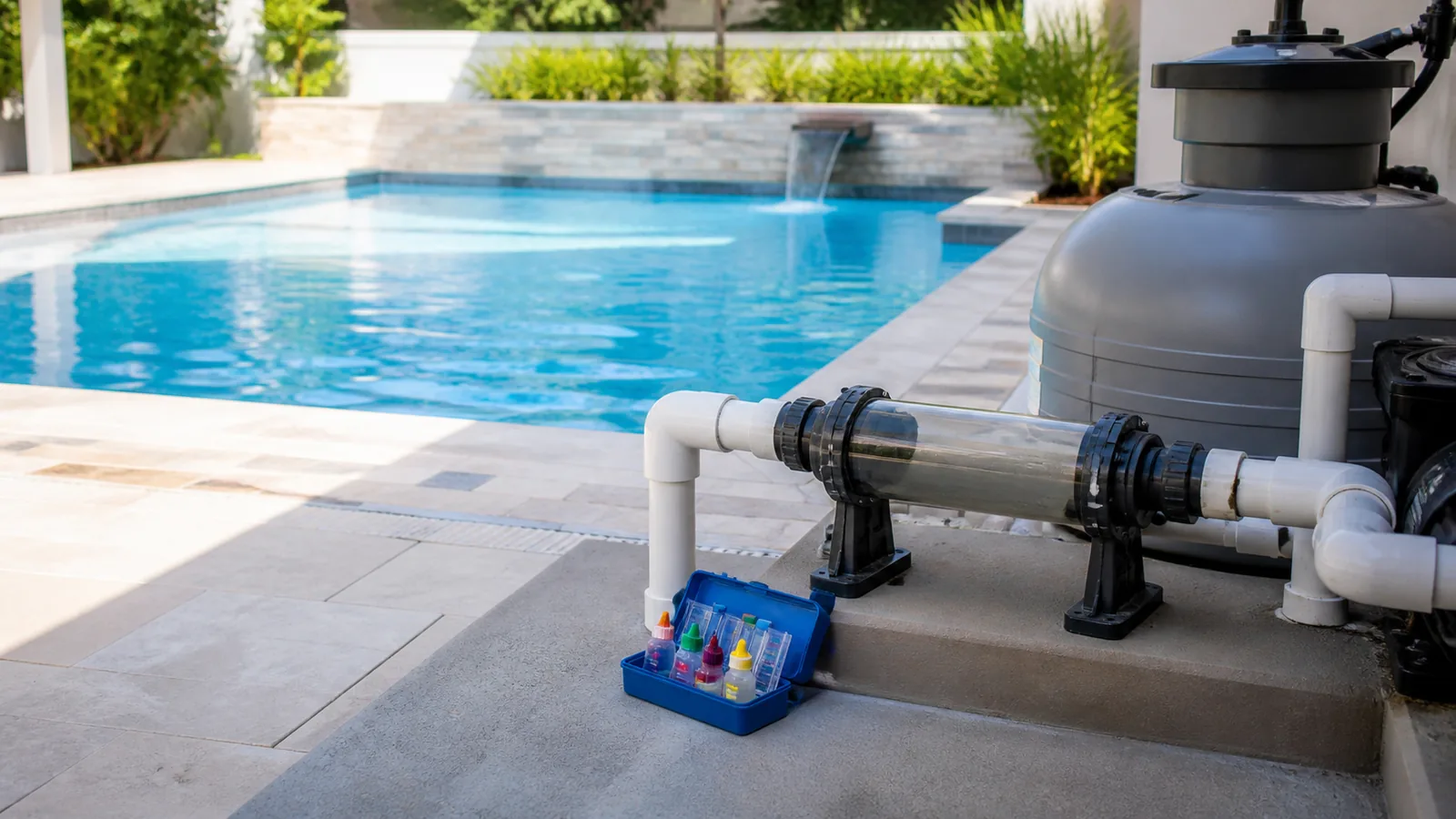
A saltwater pool is still a chlorine pool. The salt chlorine generator makes chlorine from dissolved salt, but it does not test the water, remove debris, balance pH or guarantee that daily chlorine demand is being met. Good maintenance combines water testing, circulation, cell inspection and seasonal adjustment.
This checklist is designed for residential saltwater pools. Always use the target salt range, cleaning procedure and winterization instructions for your exact generator. Current Pentair systems, for example, use model-specific salt targets and warnings that should not be copied to another brand.
Saltwater pool maintenance at a glance
| Frequency | Tasks |
|---|---|
| Before swimming / several times weekly | Check free chlorine and pH; inspect clarity, water level, flow and controller warnings |
| Weekly | Empty baskets, brush surfaces, clean as needed, review filter pressure and adjust cell output from test results |
| Monthly | Verify salinity with an independent test, inspect the cell, test total alkalinity, calcium hardness and cyanuric acid |
| Seasonally | Inspect bonding and corrosion-prone areas, review cell production, clean the filter, prepare for cold-water limits or winterization |
What a salt chlorine generator actually does
Salt dissolves into sodium and chloride ions. As pool water passes through the energized cell, electrolysis produces chlorine that sanitizes the water. After chlorine reacts, much of it returns to chloride and can be used again. Salt is still lost through splash-out, backwashing, leaks and water replacement.
The cell only produces chlorine while water is flowing and the controller permits operation. Low temperature, low flow, low salt, scaling or a depleted cell can reduce or stop output.
Water targets: follow the system, surface and sanitizer
CDC recommends pH 7.0–7.8 and at least 1 ppm free chlorine in residential pools, or at least 2 ppm when cyanuric acid is used. Generator manufacturers and pool professionals often specify narrower operating ranges. Use the most applicable manual, chemical label and local requirements.
- Free chlorine: maintain the tested level required for the pool’s cyanuric acid, use and local guidance.
- pH: test frequently because aeration at the cell and water features can contribute to upward drift.
- Total alkalinity: keep it in a range that stabilizes pH without driving excessive carbon-dioxide loss.
- Calcium hardness: balance for the surface and the complete saturation index.
- Cyanuric acid: protect outdoor chlorine from sunlight without exceeding the generator manufacturer’s range.
- Salt: use the exact cell target. Do not add salt from a generic chart without testing first.
Weekly saltwater pool checklist
1. Test free chlorine and pH
Use a dependable DPD or FAS-DPD method. Test at a consistent time and record the result. A falling chlorine trend means the pool is consuming more than the cell produces, even if the controller shows no warning.
2. Inspect the pool and equipment pad
Confirm clear water, normal return flow and the expected water level. Look for leaks, salt residue, corrosion, unusual noise and controller alerts. Do not bypass flow switches or safety interlocks.
3. Empty baskets and remove debris
Clean the skimmer and pump basket with the pump safely switched off according to the equipment manual. Debris restriction reduces flow and can stop cell production.
4. Brush and clean surfaces
Brush steps, corners, tile lines and low-circulation areas. A robotic cleaner can reduce floor debris, but it does not replace wall inspection or water testing.
5. Review filter pressure
Compare the gauge with the clean-filter baseline. Clean or backwash at the filter manufacturer’s specified pressure rise, not by an arbitrary calendar interval.
6. Adjust generator output
Change output in small steps, then retest after several representative operating days. Account for pump runtime: doubling cell percentage does not help if the pump schedule is too short or flow is interrupted. See our guide to pool-pump runtime when it becomes available.
Monthly saltwater pool checklist
Verify salinity independently
A controller estimates salt from conductivity and temperature. Confirm it with a compatible calibrated meter or salt titration test before adding salt. Pentair instructs owners to test first, add salt around the pool perimeter rather than through the skimmer, circulate thoroughly and verify again.
Inspect the cell
Shut down and isolate equipment exactly as the manual requires. Look through or remove the cell only when the procedure permits. White scale between plates reduces performance. Debris can also obstruct flow.
Test the full water balance
Measure total alkalinity, calcium hardness and cyanuric acid in addition to routine chlorine and pH. Use those values with temperature and dissolved-solids assumptions to evaluate saturation balance. Scale-forming water can coat the cell even when the pool looks clear.
Check cell-life and diagnostic data
Many modern systems report hours, voltage, current, temperature or warning history. Record abnormal trends. A clean cell that repeatedly shows low output may be worn, undersized for demand or affected by a flow, salt or chemistry problem.
How—and when—to clean a salt cell
Inspect first. Do not acid-clean on a fixed monthly schedule unless the manufacturer requires it. Acid removes calcium scale but also consumes a small amount of cell coating, so unnecessary cleaning can shorten cell life.
- Switch off power and follow lockout and pressure-relief instructions.
- Remove and inspect the cell according to the manual.
- Use a strong stream of fresh water or an approved non-metal tool if permitted.
- Use the manufacturer’s specified acid-cleaning kit and solution only when deposits remain.
- Never scrape the coated plates with metal.
- Rinse, inspect seals and reinstall in the correct flow direction.
Never mix cell-cleaning acid with chlorine or return used solution to chemical containers. Follow disposal rules on the product label and in your area.
How to add salt without overshooting
- Test current salinity with an independent method.
- Confirm pool volume and the cell’s target range.
- Calculate only the difference needed.
- Check the salt bag for purity and pool-use instructions.
- Turn the generator off if the manual requires it while salt dissolves.
- Add around the perimeter—not through the skimmer—and brush piles.
- Circulate for the specified period, then retest before restarting production.
High salt is usually corrected by water replacement, so cautious under-dosing is easier to fix than overshooting.
Seasonal maintenance
Spring startup
Inspect plumbing and the cell, restore water level, start circulation, balance water and verify salt before enabling chlorine production. A freshly plastered pool may require a waiting period before salt is added; follow the surface and generator manufacturers.
Summer demand
Hot sun, warm water, storms and swimmers increase chlorine demand. Test more often and adjust both output and pump runtime gradually. Use a manual chlorine product approved for the pool if the cell cannot catch up; do not assume “boost” solves every contamination event. For contamination or a true breakpoint-chlorination need, follow our guide to shocking a saltwater pool safely.
Cold water and winter
Many cells reduce or stop production in cold water. Switch to the closing or winter sanitation plan before chlorine falls. In freezing climates, follow complete winterization instructions and install any required spacer cell.
Troubleshooting common saltwater problems
| Symptom | Check first |
|---|---|
| Low free chlorine | Test accuracy, pump runtime, output setting, flow, cell scale, water temperature and contamination load |
| High pH every week | Total alkalinity, aeration, spillovers, cell output and acid-feed operation |
| White flakes in pool | Cell scale and complete calcium saturation balance |
| Low-salt warning after adding salt | Independent salinity test, water temperature, sensor condition and complete dissolution |
| Corrosion or rust staining | Water balance, bonding, leaks, incompatible metals and splash-out |
Frequently asked questions
Do saltwater pools need chlorine added?
The generator makes chlorine, but manual supplemental chlorine may be necessary during startup, heavy demand, equipment downtime or a treatment directed by the chemical label.
How often should I check the salt level?
Check the controller routinely and confirm salinity independently at least monthly, after major water replacement or before adding salt.
Why does the pH rise in a saltwater pool?
Carbon-dioxide loss from aeration, water features and cell turbulence can raise pH. High total alkalinity can accelerate the trend. Diagnose the complete balance instead of adding acid on autopilot.
Can I swim while the salt cell is running?
Follow the generator manual and chemical conditions. Normal operation is generally designed for an occupied pool, but swimming is unsafe during chemical treatment, electrical faults, poor visibility or out-of-range sanitizer and pH.
How long does a salt cell last?
Life depends on cell design, operating hours, output, water balance, cleaning practices and warranty terms. Use the system’s cell-life data and diagnostics rather than a universal year estimate.
Final recommendation
Treat the salt cell as one component of the sanitation system, not an automatic water-care replacement. Test chlorine and pH frequently, verify salinity independently, keep flow and filtration healthy, inspect the cell before cleaning it and adjust output from recorded results. That routine protects both swimmers and an expensive cell.