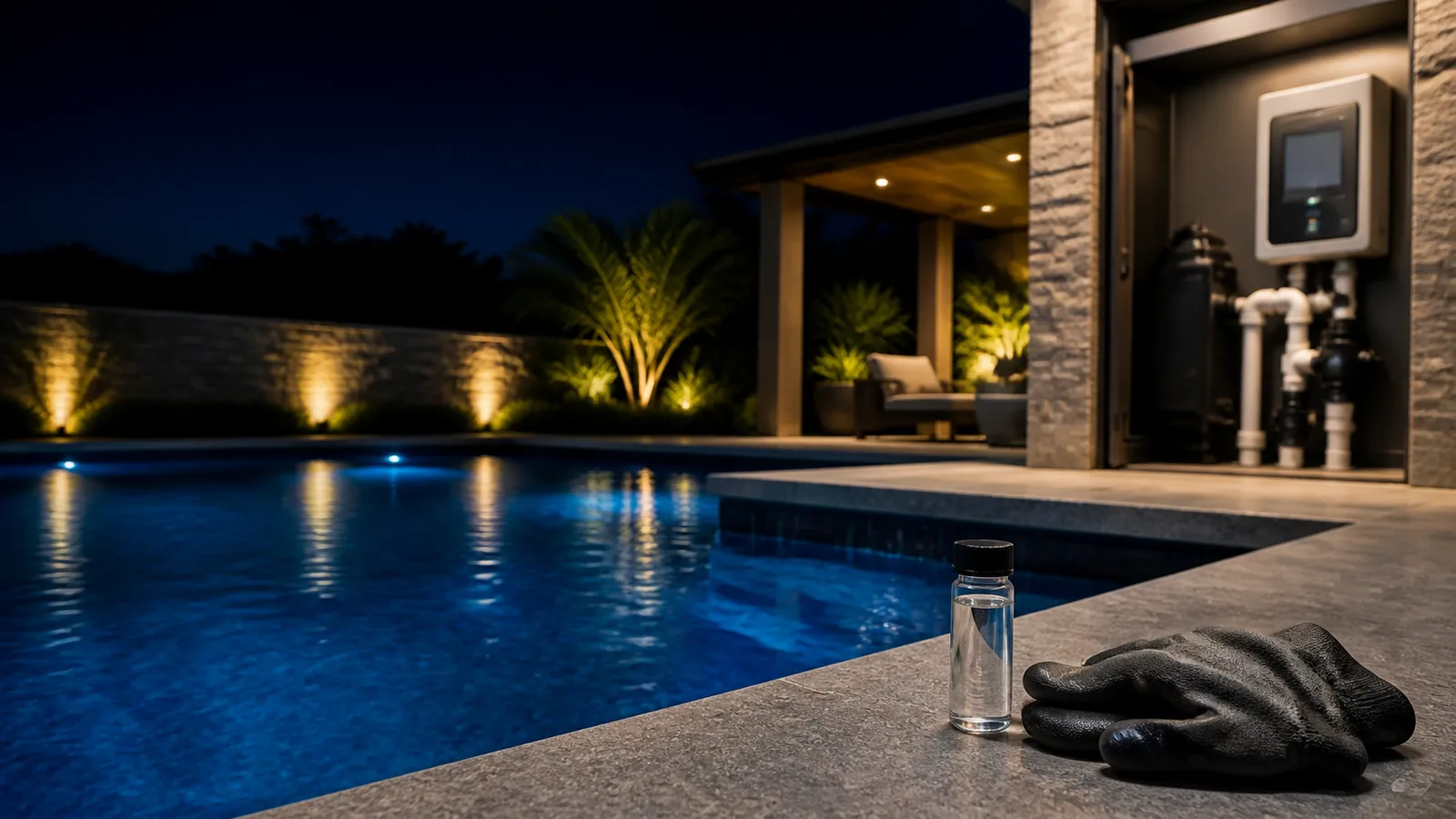
A saltwater pool is a chlorine pool. The salt cell converts dissolved chloride into chlorine, but storms, heavy swimmer load, algae or equipment problems can create a demand faster than the cell is designed to meet. “Shocking” means raising oxidation and sanitizer capacity deliberately—not pouring in an arbitrary bag because the water looks dull.
The correct dose depends on pool volume, current free chlorine, cyanuric acid, product concentration and the reason for treatment. Use measured values and the product label. This guide explains the safe process without pretending one dose fits every saltwater pool.
Do you actually need to shock?
Routine weekly shocking is not automatically necessary when free chlorine, combined chlorine, pH and water clarity remain in the correct range. Test first.
A deliberate high-chlorine treatment may be appropriate when:
- Free chlorine has fallen below the required level.
- Visible algae is present.
- Combined chlorine remains elevated after normal operation.
- A major storm or unusually heavy swimmer load has overwhelmed normal output.
- The pool has reopened after stagnation.
A fecal incident is different from routine “shock.” Follow current public-health guidance and local rules; do not improvise from an algae-treatment article.
Salt-cell boost mode vs. manual chlorination
Many generators include “Boost” or “Super Chlorinate,” which runs the cell at high output for an extended period. Pentair, for example, supports a Super Chlorinate function in current IntelliChlor and iChlor integrations. This can help with a modest temporary demand.
Boost mode is not always the fastest response to an active algae problem because a cell produces chlorine gradually. Extended maximum output also consumes cell life. A separately dosed, pool-labeled chlorinating product can raise free chlorine more predictably, but it must be compatible with the pool and used exactly as labeled.
Which shock product is best for a saltwater pool?
| Product type | What it adds | Important consideration |
|---|---|---|
| Liquid pool chlorine / sodium hypochlorite | Chlorine and some salt | Adds no calcium or CYA; strength degrades with heat and age |
| Calcium hypochlorite | Chlorine and calcium | Can be a poor fit when calcium hardness is already high |
| Dichlor | Chlorine and cyanuric acid | Repeated use raises CYA |
| Non-chlorine oxidizer | Oxidation without adding chlorine | Does not replace an inadequate sanitizer residual and may affect some tests |
Liquid pool chlorine is often the simplest way to raise free chlorine without adding calcium or CYA, but “household bleach” is not automatically interchangeable. Concentration, additives, freshness and label registration matter. Use a product labeled for pool treatment.
How to shock a saltwater pool in 7 steps
1. Keep swimmers out and verify visibility
Do not treat with people in the water. If the deepest point or drain is not clearly visible, keep the pool closed regardless of the test result.
2. Remove debris and brush
Empty baskets, skim the surface and brush walls, steps and the floor. Organic debris consumes chlorine and can shelter algae.
3. Test a complete panel
Measure free chlorine, combined chlorine, pH and CYA with a reliable kit. Check total alkalinity, calcium hardness and salt when relevant. A FAS-DPD chlorine test is particularly useful because it can measure elevated chlorine without relying on a narrow color block.
4. Correct pH if needed
CDC recommends pH 7.0–7.8 for residential pools. Use the product and target appropriate for the system. Never add acid and chlorine together or through the same contaminated measuring equipment.
5. Calculate the chlorine addition
Use the pool’s verified gallons, measured free chlorine, target free chlorine and the product’s exact concentration. The appropriate target depends on CYA and the treatment objective. Follow the EPA-registered label and generator manufacturer’s limits.
6. Add the product with circulation running
Follow the label’s method and location. Keep concentrated chemical away from the salt cell, skimmer and vulnerable surfaces unless the manufacturer explicitly directs otherwise. Brush any settled product only when the label permits.
7. Circulate, filter and retest
Run the pump for the label-specified time, monitor the filter and retest free chlorine before making a second addition. Visible algae requires continued brushing and filtration after chlorine has done its work.
How to protect the salt cell
- Do not pour concentrated acid or chlorine into the skimmer unless the system manufacturer explicitly requires it.
- Do not run the cell without adequate flow.
- Do not combine maximum cell output with manual treatment by habit; decide what each addition is meant to achieve.
- Keep calcium balance and pH controlled to reduce cell scaling.
- Inspect and clean the cell only by the manufacturer’s procedure—unnecessary acid cleaning can shorten coating life.
When is it safe to swim again?
Use the re-entry statement on the exact chemical label and confirm that free chlorine and pH have returned to the permitted range. The water must also be clear enough to see the deepest point. Do not rely on elapsed time alone.
Common saltwater shocking mistakes
- Assuming the salt reading is the same as the chlorine reading.
- Using boost mode for active algae and waiting several days for a result.
- Adding stabilized chlorine repeatedly without tracking CYA.
- Using cal-hypo when calcium hardness is already high.
- Adding a second product before retesting the first dose.
- Mixing chemicals or using a scoop contaminated by another product.
Frequently asked questions
Should I turn off the salt cell while shocking?
Follow the generator manual and your treatment plan. Circulation must continue, but you may set the cell to normal or off while a separately calculated chlorine dose is doing the work. Avoid unintentionally stacking maximum cell output and manual dosing.
Does shocking increase the salt level?
Some chlorinating products leave chloride behind, but a normal treatment usually changes salinity far less than a deliberate salt addition. Test salt separately before adding bags.
Can I use non-chlorine shock?
It can oxidize some contaminants, but it does not replace adequate free chlorine and may interfere with certain combined-chlorine tests. Use it only for a defined purpose and follow the label.
Final verdict
Shock a saltwater pool only after testing explains why it is needed. Choose a product that will not worsen calcium or CYA, calculate from actual volume and concentration, keep circulation running and retest before adding more. The salt cell is a steady chlorine generator—not a substitute for accurate diagnosis or safe chemical handling.