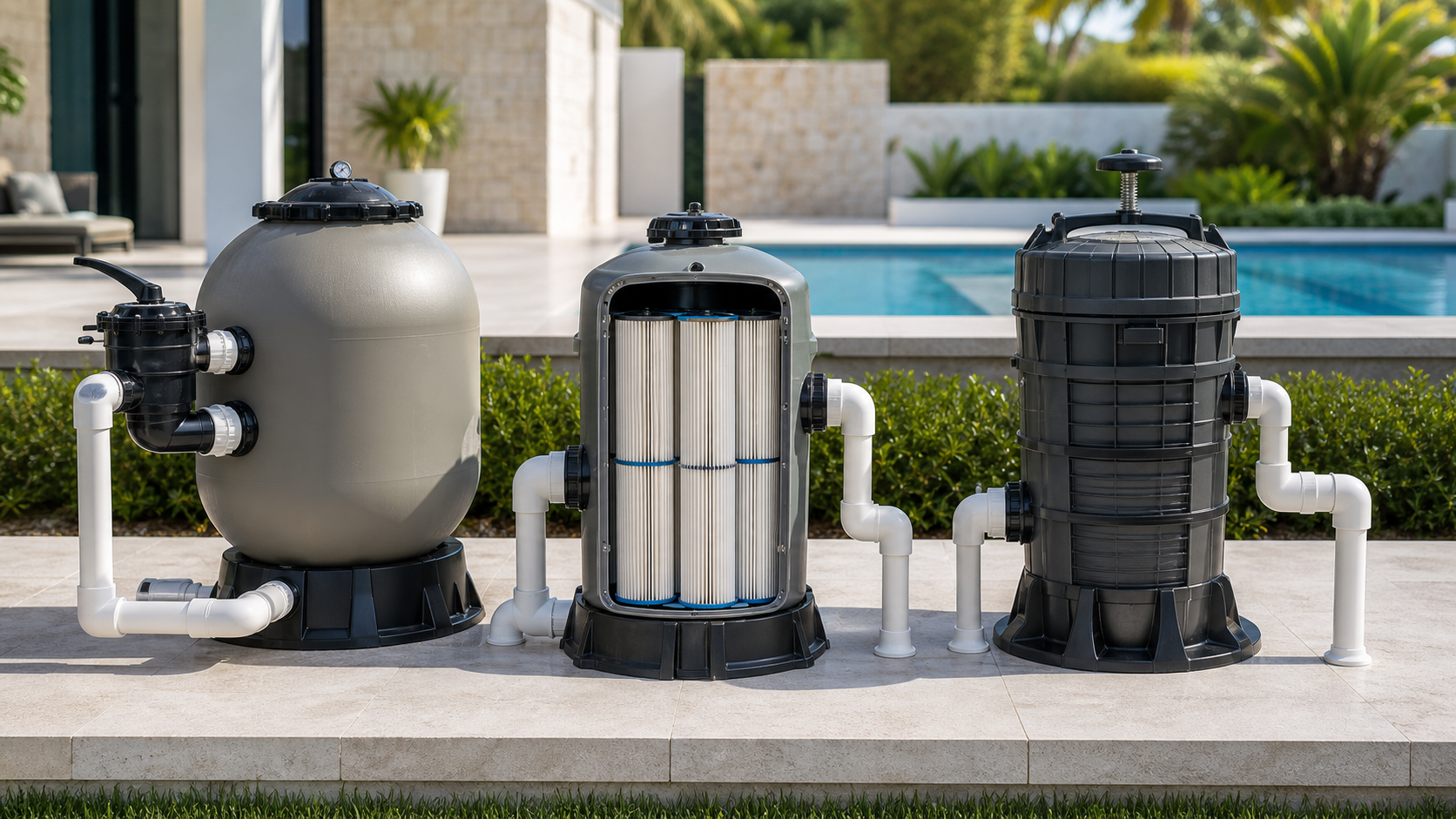
Sand, cartridge and diatomaceous earth (D.E.) filters can all keep a residential pool clear when they are correctly sized, operated and maintained. The meaningful differences are how much fine material each design can capture, how much water and labor cleaning requires, the pressure loss it adds to the system and what ownership tasks you are willing to accept.
This guide compares the three filter types using current manufacturer specifications and safety manuals. It does not assume that one design is universally best. Plumbing, pump flow, local discharge rules, pool size and debris load can change the right answer.
Sand vs. cartridge vs. D.E.: comparison table
| Filter type | Best fit | Routine cleaning | Main advantage | Main drawback |
|---|---|---|---|---|
| Sand | Owners prioritizing durability and simple backwashing | Backwash and rinse through a multiport or backwash valve | Simple media bed and long service life | Backwashing uses pool water and needs a legal discharge route |
| Cartridge | Most residential pools, especially where water conservation matters | Remove and rinse cartridges after depressurizing the tank | Large surface area with no backwashing | Elements eventually require replacement and careful cleaning |
| D.E. | Owners seeking very fine filtration and prepared for more service | Backwash or disassemble, clean grids and recharge with the specified D.E. amount | Excellent fine-particle capture | More complex handling, disposal and grid maintenance |
Manufacturers do not use one universal micron test across every model, media condition and flow rate. Treat broad micron claims as guidance, not a promise that every particle above or below a number will behave identically.
How a sand pool filter works
A sand filter sends pool water through a bed of graded media. Suspended material becomes trapped within the bed while filtered water returns through laterals at the bottom of the tank. As the bed loads with debris, resistance rises and the gauge pressure generally increases.
Cleaning reverses the flow so trapped material leaves through the waste line. A rinse step then settles the bed before filtration resumes. This is convenient, but it removes treated pool water. The discharge must go to an approved location and must not damage landscaping, neighboring property or a storm-water system.
Current examples show why model-level specifications matter. Pentair lists the Triton II TR60 at a 63 GPM commercial flow rating with 325 pounds of media, while the larger TR100 uses 600 pounds and is rated at 74 GPM. Hayward’s current ProSeries data lists the S244T at 62 GPM and the S270T at 74 GPM. Those are filter ratings, not proof that a particular pool will actually flow at that rate.
Choose sand when:
- You want a mechanically simple filter with widely available media and parts.
- Your property has a safe, legal backwash-discharge route.
- You prefer short backwash sessions to removing and washing cartridges.
- Your debris load is heavy enough that frequent cartridge cleaning would be inconvenient.
Think twice when:
- Water is expensive or discharge is restricted.
- You expect a compact equipment pad: large sand tanks need clearance and become extremely heavy when filled.
- You are chasing fine suspended haze that may require better chemistry, coagulation guidance or a different filter strategy.
How a cartridge pool filter works
A cartridge filter directs water through pleated polyester elements. The pleats provide a large effective surface area inside a relatively compact tank. There is no backwash cycle; the elements are removed and rinsed after the filter has been safely isolated and depressurized.
Large multi-element filters reduce the frequency of cleaning because they spread the debris load across hundreds of square feet. Pentair lists its Clean & Clear Plus CCP420 at 420 square feet and 150 GPM, while Jandy lists the CV460 at 460 square feet and a maximum flow of 150 GPM. Actual system flow still depends on plumbing and other equipment.
Cartridge filters are often the most balanced residential choice. They avoid backwash water loss, usually operate with relatively low resistance when clean and do not require D.E. powder. Their weakness is ownership discipline: blasting pleats at close range, using the wrong chemical or reinstalling damaged elements can shorten cartridge life.
Choose cartridge when:
- You want to conserve pool water and avoid a waste line.
- You can provide enough clearance to remove the cartridges safely.
- You prefer occasional element cleaning to regular backwashing.
- You use a variable-speed pump and value a generously sized, low-restriction filter.
Think twice when:
- The pool receives extreme quantities of fine dust, algae or construction debris.
- You cannot comfortably lift and wash the elements.
- Replacement-cartridge availability for the exact model is uncertain.
How a D.E. pool filter works
A traditional D.E. filter uses a grid assembly coated with a measured charge of diatomaceous earth. The powder creates a fine filtration layer. When the filter is cleaned or backwashed, the coating is removed and must be replaced with the amount specified for the model.
Pentair’s current FNS Plus family ranges from 48 GPM for the 24-square-foot model to 120 GPM for the 60-square-foot model. Pentair says the curved-grid design increases filtration area and that the filter should be cleaned when pressure reaches roughly 10 PSI above the clean starting pressure or flow drops substantially.
D.E. can deliver excellent clarity, but it is not a set-and-forget choice. Grid condition, correct recharge quantity, discharge rules and powder handling all matter. Some jurisdictions restrict how D.E. waste may be discharged. Follow the manufacturer manual and local requirements.
Choose D.E. when:
- Your priority is fine-particle capture and polished-looking water.
- You accept more involved cleaning and media handling.
- A local service professional is experienced with the model.
Think twice when:
- You want the simplest possible maintenance routine.
- Your local discharge requirements make D.E. handling difficult.
- You are unlikely to measure the recharge amount accurately.
Pressure, flow and filter size matter more than the label
The gauge reading on a clean filter is a baseline for that specific pool at that specific pump speed and valve configuration. It is not a universal target. Jandy’s CV manual, for example, lists a normal startup range of 6–15 PSI, but another plumbing system may operate differently.
Record the clean pressure after installation and after each thorough cleaning. Many manufacturers use an increase of about 8–10 PSI as a cleaning trigger, but the exact manual takes priority. Our pool-filter pressure guide explains how to distinguish a dirty filter from a closed valve, blocked return, air leak or oversized pump.
Do not select a filter only by advertised pool capacity. Confirm:
- the maximum possible pump flow at the programmed speeds;
- the filter’s design or maximum flow rating;
- pipe size and total dynamic head;
- heater, chlorinator, cleaner and water-feature flow requirements;
- the physical clearance required to open and service the filter;
- local turnover and installation requirements.
Slower filtration can be more energy efficient and reduce system resistance. The U.S. Department of Energy notes that variable-speed pumps can reduce energy use by operating at the flow needed for each task rather than forcing one high speed. Our Equipment & Tech library covers the pump side of the system, including runtime and variable-speed guidance.
A filter cannot correct bad water chemistry
A filter removes suspended material; it does not sanitize the pool. Cloudy water can come from active algae, poor circulation, an incorrect pH, high calcium saturation, environmental debris or a filter problem. Cleaning or replacing the filter without correcting the underlying chemistry may produce only temporary improvement.
Test the water with an appropriate kit before assuming the filter is defective. Our test-strips vs. liquid-kits comparison explains the limitations of each method. If rain triggered the problem, follow the diagnosis sequence in our cloudy-pool-after-rain guide.
Which pool filter should you choose?
- Best all-around for many residential pools: an oversized cartridge filter with readily available replacement elements.
- Best for straightforward mechanical durability: a correctly sized sand filter with a safe backwash route.
- Best for the finest clarity: a D.E. filter maintained by an owner or professional comfortable with grids and media recharge.
- Best for a small above-ground package: a matched pump-and-filter system designed for that pool volume and hose size.
Oversizing within manufacturer and site limits is often useful because a larger filter can reduce cleaning frequency and resistance. It does not eliminate the need to keep flow below the filter rating or to follow local code.
Frequently asked questions
Which pool filter requires the least maintenance?
A sand filter usually offers the quickest routine cleaning through backwashing, while a large cartridge filter may go longer between cleanings. The easier option depends on debris load, water restrictions and whether you prefer handling cartridges or discharging backwash water.
Is a cartridge filter better than a sand filter?
It is often better for water conservation and a low-resistance residential system. Sand may be better where rugged simplicity and quick backwashing matter more. Correct sizing and maintenance have a larger effect than the category name alone.
Can I replace a sand filter with a cartridge filter?
Usually, but it is not always a direct swap. A professional should verify flow, pipe connections, equipment-pad space, electrical isolation, sanitizing equipment and service clearance. The old backwash line must be handled correctly.
Why does my pool stay cloudy with a new filter?
The cause may be active algae, unbalanced water, insufficient circulation, a bypassed or damaged element, incorrect valve position or material too fine for the present setup. Diagnose chemistry and hydraulics before buying another filter.