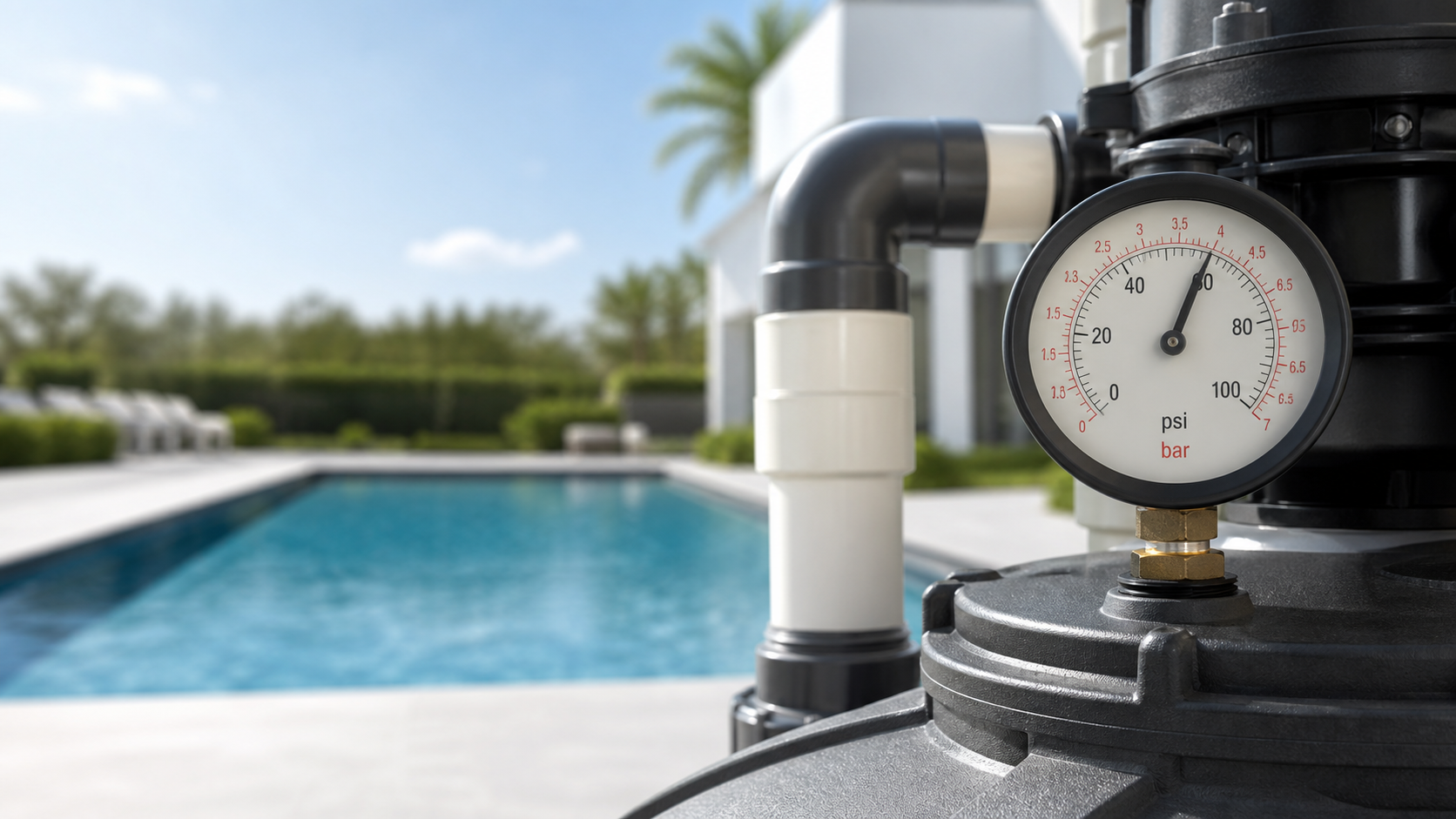
Pool filter pressure is not a grade. A higher number is not automatically dangerous, and a lower number is not automatically efficient. The useful measurement is the difference between today’s reading and the clean starting pressure for the same pump speed and valve configuration.
What is normal pool filter pressure?
There is no universal normal pressure for every pool. Pipe diameter, equipment-pad distance, fittings, heater, chlorinator, filter type, pump speed and return fittings all affect the gauge. Jandy’s current CL/CV cartridge-filter manual lists a normal startup range of 6–15 PSI for those models, but that range should not be applied blindly to a different installation.
Your clean baseline is more valuable:
- Clean or backwash the filter according to its manual.
- Confirm baskets are clean and valves are in their normal filtration positions.
- Bleed trapped air according to the filter instructions.
- Run the pump at the speed you normally use for filtration.
- Record pressure, pump RPM and any flow-meter reading.
Repeat this for other regularly used speeds. A variable-speed pump can produce very different gauge readings at low and high RPM.
When does pressure mean the filter needs cleaning?
Pentair tells owners of Clean & Clear Plus cartridge filters and FNS Plus D.E. filters to clean at approximately 10 PSI above the original starting pressure. Pentair’s Clean & Clear RP support uses an 8–10 PSI increase. The manual for your exact model takes priority.
Pressure rise occurs because captured debris adds resistance. Water flow can fall as pressure rises. Do not repeatedly increase pump speed to hide a clogged filter: that adds energy use and may push another component outside its intended flow range.
Why pool filter pressure is high
1. The filter is dirty
This is the most common gradual cause. Sand needs backwashing, cartridge elements need safe removal and rinsing, and D.E. grids need the cleaning and recharge procedure specified by the manufacturer.
2. A return valve is closed or partly closed
A restriction after the filter increases pressure upstream. Check valve positions, return fittings and any recently adjusted spa, water-feature or heater bypass.
3. Return fittings are too restrictive
Small eyeball fittings or blocked returns can increase pressure. Jandy lists a small return eyeball and a partly closed return valve among high-pressure causes.
4. The pump speed is higher
Comparing 1,500 RPM one day with 3,000 RPM the next is not a meaningful filter test. More flow creates more resistance. Compare readings at the same programmed speed.
5. The pump is oversized for the filter or plumbing
A pump can produce more flow than the filter’s design rating. Jandy identifies excessive pump output as a cause of short cycles, while manufacturer filter tables publish model-specific maximum flow. Match the whole system, not the horsepower labels.
6. The filter was cleaned incorrectly
Cartridges can remain clogged with oils or scale even when the surface looks cleaner. Sand can channel or clump, and D.E. grids can be incorrectly recharged. Follow the exact maintenance instructions rather than improvising chemical treatments.
Why pool filter pressure is low
Low pressure usually indicates reduced water reaching the pump or the gauge—not a filter that is “extra clean.” Check:
- pool water level and skimmer weir movement;
- skimmer and pump baskets;
- closed suction valves;
- a clogged pump impeller;
- air leaks at the pump lid, drain plugs or suction plumbing;
- a variable-speed schedule that has changed;
- a faulty gauge.
Air bubbles in the pump basket or returns point toward a suction-side air leak. Shut the system down if it cannot prime or if the pump runs dry.
Why the pressure gauge reads zero
A zero reading with the pump off and pressure relieved is correct. A zero reading while water is clearly circulating may mean the gauge is stuck, its port is blocked or the gauge has failed. Pentair says the gauge should return to zero when the system is off, show pressure when operating and remain readable and undamaged.
If there is no circulation and the gauge reads zero, diagnose the pump, water level, valves and suction path before blaming the gauge.
What a sudden pressure spike means
Shut the pump off if pressure jumps suddenly, approaches the equipment limit, or is accompanied by unusual noise, movement or leaks. Possible causes include a closed return valve, blocked line, incorrect multiport position or internal failure. Do not stand over the filter or attempt to tighten a pressurized clamp.
Many residential filters in this cluster publish a maximum working pressure of 50 PSI, but that is a structural operating limit—not a target. Another system component may have a lower limit.
A safe troubleshooting sequence
- Turn off the pump if the reading is sudden, extreme or abnormal.
- Confirm the gauge returns to zero after pressure is relieved.
- Check water level, skimmer basket and pump basket.
- Verify suction and return valves are in normal filtration positions.
- Look for air in the pump basket or return stream.
- Compare pump RPM with the recorded clean-baseline RPM.
- Clean the filter only through the model’s safe procedure.
- Restart, bleed air as instructed and record the new pressure.
- Call a professional if pressure remains abnormal or the tank, clamp, valve or plumbing leaks.
High pressure and cloudy water are different problems
A dirty filter can contribute to poor circulation, but a clear pressure gauge does not prove the water is sanitized. Algae, pH, calcium balance and sanitizer demand must be tested separately. Start with our pool testing comparison and cloudy-water diagnosis.
Variable-speed pumps change the reading
The U.S. Department of Energy notes that lower-speed operation can reduce energy use and can suit filtration, while high-flow tasks may require different settings. Record a baseline for each important program instead of expecting one pressure number all day. See the Equipment & Tech library for our pump-runtime and variable-speed guidance.
Frequently asked questions
Is 20 PSI too high for a pool filter?
Not necessarily. If clean pressure is 10 PSI, 20 PSI may be a cleaning trigger. If clean pressure is 18 PSI at the same speed, 20 PSI may be normal. Compare with the clean baseline and the manufacturer’s limit.
Should I clean the filter every time pressure rises?
First confirm the pump speed and valve positions have not changed. If the rise is gradual and reaches the manual’s cleaning threshold, clean or backwash as directed.
Why is pressure high immediately after cleaning?
Possible causes include an incomplete cleaning, scaled cartridges, incorrect D.E. recharge, a closed return, restrictive fitting, trapped air procedure error or excessive pump speed. Stop and inspect the safe, external checks before reopening the filter.
Can I replace the pressure gauge myself?
Only with the pump isolated, pressure fully relieved and a compatible gauge installed according to the manual. If the filter closure or air-relief assembly is involved, use a qualified service professional.