Learning how to lower total alkalinity in a pool safely starts with measured stages, not one dramatic acid dose. High total alkalinity makes pH difficult to control and can contribute to repeated pH rise, cloudy water and scale-forming conditions. Protect pH and circulation, and retest between additions.
This guide explains the chemistry behind the process and provides a cautious workflow. Exact chemical quantity depends on pool volume, starting alkalinity, pH, acid strength, cyanuric acid and the product label. When those inputs are uncertain, use an acid-demand test or a qualified pool professional.
How to lower total alkalinity without crashing pH
- Verify pool volume and retest total alkalinity and pH with a dependable kit.
- Set a staged target rather than trying to correct the entire difference at once.
- Calculate the dose from the exact acid product and strength.
- With circulation operating as directed by the label, add the measured dose safely.
- Allow thorough mixing, then retest after the label’s waiting period.
- If pH is low, use aeration to release carbon dioxide and let pH rise without adding alkalinity.
- Repeat only after the previous dose is fully mixed and verified.
Orenda’s technical guidance recommends reducing total alkalinity gradually—generally no more than 20 ppm in a treatment stage—to avoid an excessive temporary pH and saturation-index drop. That is a conservative operational limit, not a substitute for the chemical label.
Total alkalinity and pH are related—but not the same
| Measurement | What it describes | Why it matters |
|---|---|---|
| pH | How acidic or basic the water is at that moment | Swimmer comfort, disinfectant performance, corrosion and scale |
| Total alkalinity | The water’s acid-neutralizing capacity, dominated by bicarbonate in most pools | How strongly the water resists a downward pH change |
| Calcium saturation balance | Interaction of pH, alkalinity, calcium, temperature and dissolved solids | Whether water tends toward scale formation or corrosive behavior |
LaMotte describes total alkalinity as the water’s ability to resist pH change and lists a general pool range of 80–120 ppm. The correct operating target can vary with sanitizer type, surface, calcium hardness, cyanuric acid and the complete saturation balance. Do not chase one number while ignoring the rest of the water.
Why acid lowers both alkalinity and pH
Acid adds hydrogen ions that react with bicarbonate alkalinity and form carbonic acid, which exists in equilibrium with dissolved carbon dioxide and water. This consumes alkalinity and lowers pH. As carbon dioxide leaves the water, pH rises again while the alkalinity reduction largely remains.
That is why the controlled acid-and-aeration method works. Acid performs the alkalinity reduction; aeration helps pH recover by accelerating carbon-dioxide loss. Aeration alone raises pH but does not materially reduce total alkalinity.
Step 1: confirm that alkalinity is actually high
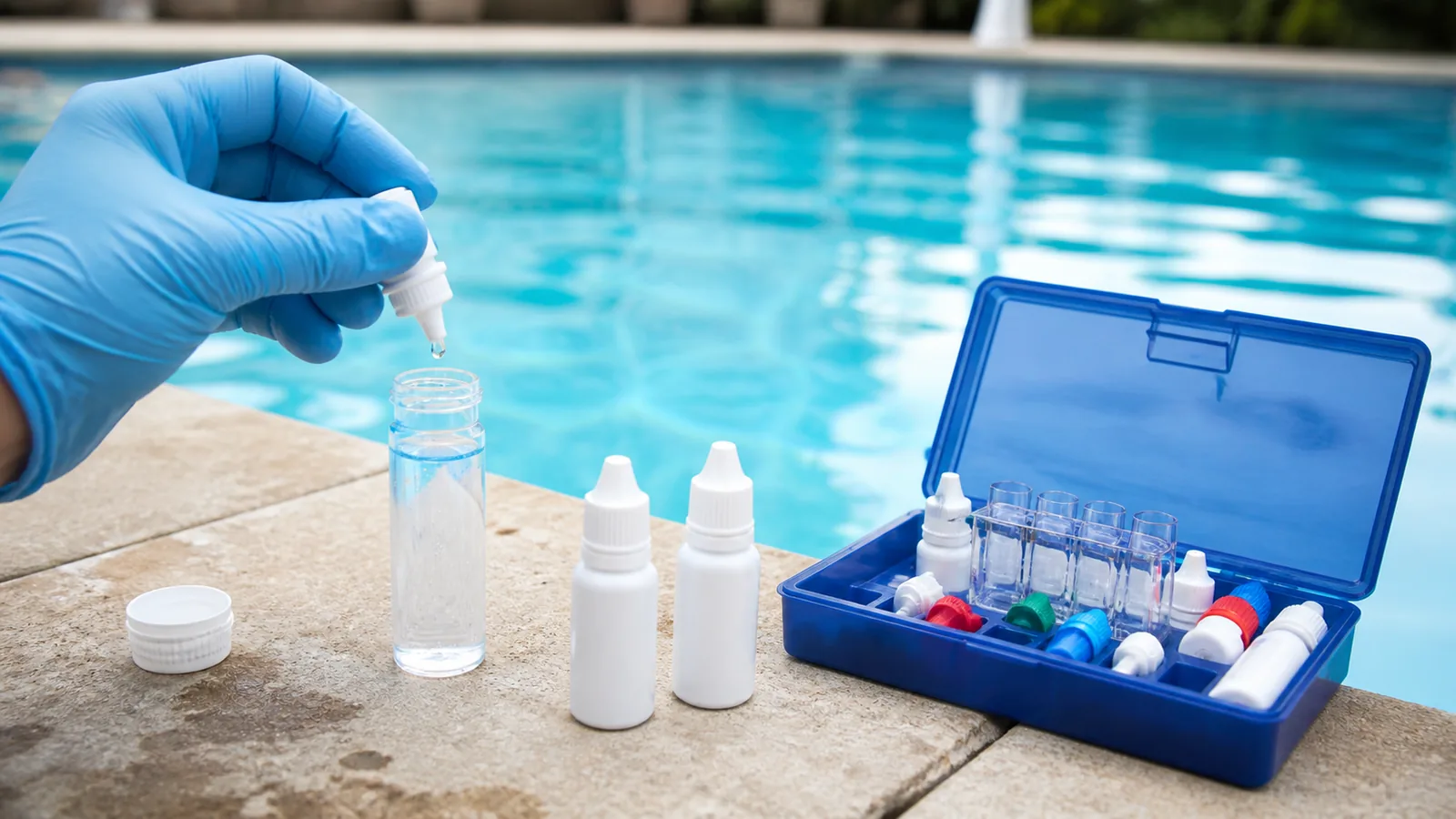
Use a titration-based test with fresh reagents when accuracy matters. Test strips are useful for screening, but small color differences can be difficult to interpret. If the result is surprising, confirm it before adding acid.
- Take the sample away from return jets and chemical feeders.
- Use the sample volume and drop-count method exactly as instructed.
- Record pH, total alkalinity, calcium hardness, water temperature and cyanuric acid.
- Check whether high sanitizer levels interfere with the test kit.
- Confirm the real pool volume.
High cyanuric acid contributes to a total-alkalinity test and may require a correction when calculating carbonate alkalinity and saturation balance. Use the test or calculation method specified by your water-balance system.
Step 2: calculate a staged acid dose
Muriatic acid and sodium bisulfate are sold in different strengths. Never reuse a dosage number without matching the exact product concentration and pool volume. Use the label, an acid-demand test or a calculator that accepts acid strength.
A staged target of 10–20 ppm is easier to verify than a large correction. It also limits how far pH and the saturation index can fall before mixing and aeration occur.
Step 3: add acid safely
- Close the pool to swimmers.
- Start the circulation pattern required on the product label.
- Wear chemical-resistant protection specified by the manufacturer.
- Measure with dedicated, compatible equipment.
- If the label permits dilution, add acid to water—never water to concentrated acid.
- Distribute the product only as directed, away from metal fittings and the skimmer.
- Brush any treated area if the label instructs it.
Never pour acid and chlorine in the same location or handle both with contaminated tools. Store them separately in their original containers.
Step 4: aerate to recover pH
After the acid is fully mixed and the pool is safe to operate, aeration can raise pH without adding bicarbonate back. Use installed features such as spa jets, deck jets, returns aimed toward the surface or a waterfall. Keep circulation running and avoid creating unsafe spray or overspray.
Aeration speed varies with water temperature, surface agitation, cover position and starting carbon-dioxide level. Do not add a “pH increaser” automatically; many alkaline products raise total alkalinity and undo part of the correction.
Step 5: retest before repeating
Wait for complete mixing according to the product label and test-kit instructions. Record the new pH and alkalinity. If alkalinity remains above the chosen target but pH is still low, continue aeration before another acid stage.
Stop and seek professional help if pH falls below the test range, the calculation does not match the observed change, the pool has a new plaster finish, or metals and surface stains appear.
Why total alkalinity keeps returning high
- High-alkalinity fill water: evaporation and top-ups continually add bicarbonate.
- Overuse of sodium bicarbonate: baking soda directly raises total alkalinity.
- Uncorrected testing error: old reagents or endpoint misreading can produce a false target.
- Automatic chemical feed: controller settings may treat pH without addressing the full balance.
- Wrong pool volume: repeated under-dosing appears as resistant alkalinity.
If baking soda was added recently, read our guide to baking soda in pools before making another correction.
Common mistakes to avoid
- Trying to lower alkalinity with aeration alone.
- Using a dose calculated for a different acid strength.
- Adding a full correction in one treatment.
- Pouring acid into the skimmer or near chlorine equipment.
- Adding alkaline pH increaser immediately after every acid dose.
- Ignoring calcium hardness, cyanuric acid and water temperature.
Frequently asked questions
Will muriatic acid lower total alkalinity?
Yes. It neutralizes bicarbonate alkalinity and also lowers pH. The dose must match the exact concentration, pool volume and test results.
Can I lower alkalinity without lowering pH?
Not directly with acid. Acid temporarily lowers both. Controlled aeration then raises pH by removing carbon dioxide without restoring the alkalinity that was neutralized.
Does dry acid work?
Sodium bisulfate can lower pH and alkalinity when the product is approved for the pool. Follow its label and consider long-term sulfate accumulation and equipment-manufacturer restrictions.
How quickly can I repeat a dose?
Only after the previous dose has mixed completely and the label’s retest interval has passed. Verify pH and alkalinity before every additional treatment.
What if both pH and alkalinity are high?
A staged acid treatment addresses both initially. As pH approaches the desired range, use test results and the full saturation balance to decide whether further alkalinity reduction is appropriate.
Final recommendation
Lower total alkalinity as a controlled sequence: verify, calculate, dose, mix, aerate and retest. Small treatment stages protect the surface and equipment while producing data you can trust. The goal is stable, sanitary and balanced water—not the lowest possible alkalinity number.