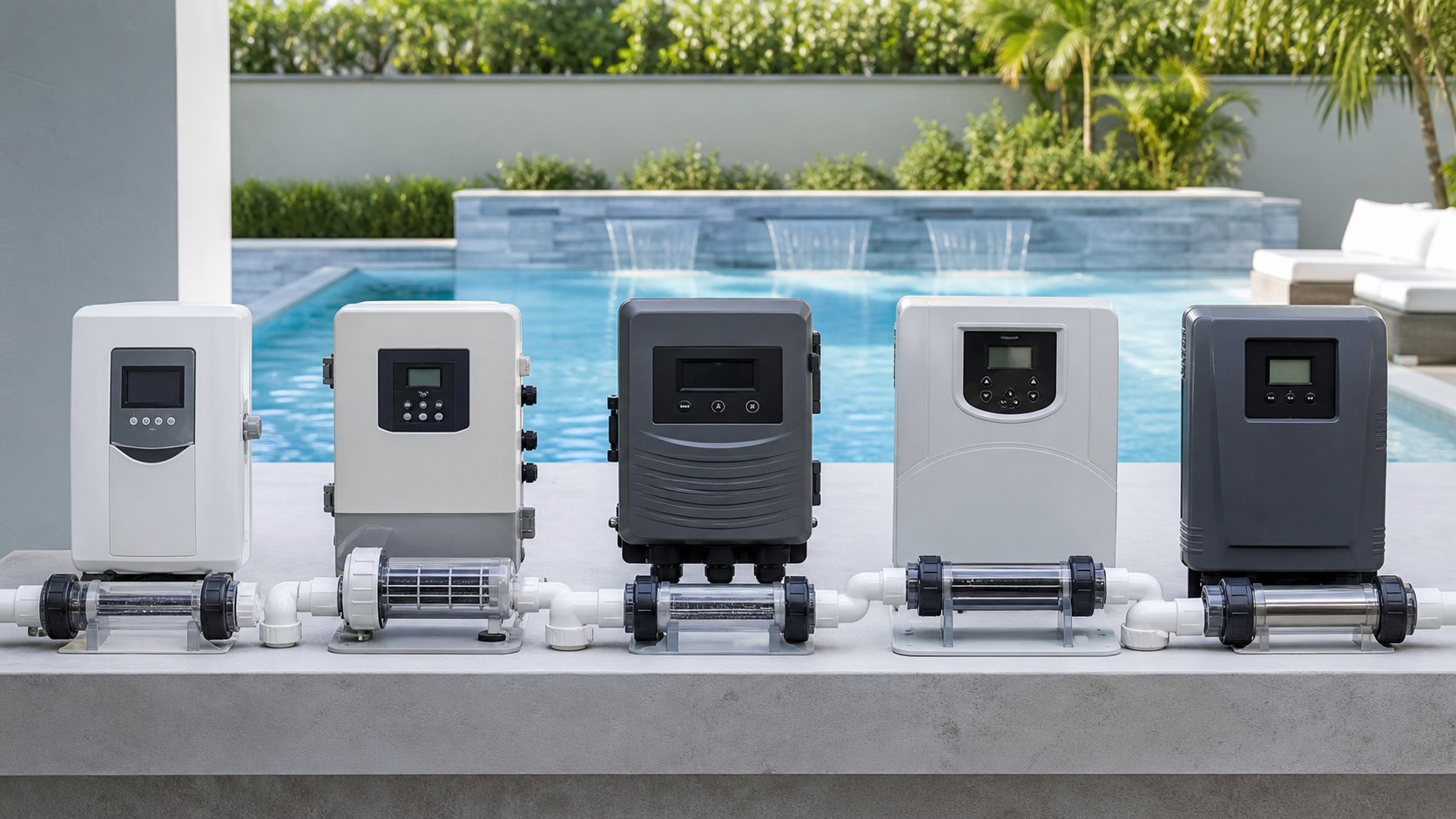
A salt chlorine generator does not create a chlorine-free pool. It converts dissolved chloride into chlorine while the circulation system is running. The correct system must produce enough chlorine on the hottest, busiest days without operating at 100% around the clock.
For this 2026 guide, Smart Poolside compared current manufacturer capacity ratings, daily chlorine output, salt and flow requirements, self-cleaning behavior, automation options and replacement-cell availability. We selected five systems for different owners and equipment ecosystems.
Affiliate disclosure: As an Amazon Associate, we earn from qualifying purchases. If you buy through links on this page, Smart Poolside may earn a commission at no extra cost to you. Recommendations remain editorially independent.
Best salt chlorine generators: quick picks
| System | Best for | Documented capacity/output | Main caution |
|---|---|---|---|
| Pentair IntelliChlor Plus40 | Best overall | 40K class; 1.40 lb chlorine/24 hr | Requires correct power center or automation bundle |
| Hayward AquaRite S3 Omni | Best combined salt and smart control | Broad 800–8,000 ppm supported salt range | Cell size and Omni package must be confirmed |
| Jandy AquaPure PLC1400 | Best for Jandy/AquaLink pools | Up to 40,000 gal; 1.25 lb/24 hr | Cell kit needs compatible power center |
| CircuPool RJ-45 Plus | Best high-output direct purchase | 45,000 gal maximum; 1.9 lb/day | Maximum rating assumes favorable conditions |
| AutoPilot Pool Pilot Digital Nano+ | Best diagnostic compact system | Up to 32,000 gal with PPC2 manifold | Lower output ceiling than larger picks |
Specifications checked August 26, 2026. Capacity ratings are manufacturer maximums, not promises for every climate. Verify current part numbers, warranty, cell, power supply and unions.
How we evaluated salt systems
- Chlorine output: pounds or grams produced in 24 hours at 100%.
- Real capacity: whether output leaves headroom for heat, sun, rain and bather load.
- Flow and salt range: the system must stay enabled at efficient pump speeds.
- Controls: output adjustment, diagnostics, salinity display and automation.
- Service: replacement-cell cost, power-center compatibility and warranty channel.
A gallon rating without a daily-output figure is incomplete. Two 40,000-gallon systems can produce materially different amounts of chlorine.
1. Pentair IntelliChlor Plus40: best overall
IntelliChlor Plus40 replaces the legacy IC40 size in Pentair’s current lineup. Pentair documents 1.40 pounds of chlorine per 24 hours at 100% output. The Plus family includes 30K, 40K and 60K cells, while LT versions cover smaller pools.
Pentair specifies a 25 GPM minimum to activate the internal flow switch and 80 GPM maximum before a bypass is recommended. Firmware includes SmartSense behavior when paired with selected Pentair pumps or covers, and periodic polarity reversal helps reduce scale.
Choose Plus40 when the pool is comfortably below its practical output limit and the equipment pad uses Pentair controls. Hot sunny pools near 40,000 gallons should be evaluated against the 2.0 lb/day Plus60 instead of relying on the label.
2. Hayward AquaRite S3 Omni: best salt plus smart control
AquaRite S3 stands out because it can combine salt production with basic pool-pad control. Hayward states that all S3 models can control chlorination, a compatible variable-speed pump and heater; the S3 Omni version adds the Omni app and broader integration.
The family supports a published 800–8,000 ppm salt-concentration range. That flexibility does not mean any salt level is optimal for the exact cell or pool surface. Follow the installed model’s manual and confirm the TurboCell capacity included in the bundle.
Choose AquaRite S3 Omni when pump, heater and sanitation need coordinated Hayward control but a flagship OmniLogic panel would be unnecessary.
3. Jandy AquaPure PLC1400: best for AquaLink pools
Jandy rates PLC1400 for pools up to 40,000 gallons and documents 1.25 pounds of chlorine per 24 hours. Its Tri-Sensor provides flow, temperature and salinity information, while AquaLink integration supports monitoring and output adjustment.
The cell kit is not a standalone system. Jandy specifies APUREM power electronics for standalone use or a compatible PureLink power center. Online listings must be checked for the cell, sensor, unions and power components actually included.
Choose AquaPure when an AquaLink installation already exists or when PureLink can combine the automation and salt power equipment cleanly.
4. CircuPool RJ-45 Plus: best high-output direct option
RJ-45 Plus publishes one of the highest outputs in this group: 1.9 pounds per day with a 45,000-gallon maximum rating. The clear cell, OLED display, salinity status, boost mode and reverse-polarity cleaning make day-to-day diagnostics straightforward.
The manufacturer’s capacity page explicitly notes that gallon ratings are maximum limits in ideal conditions. A hot 35,000-gallon pool can demand more chlorine than a shaded 45,000-gallon pool. Use the output figure and an observed daily chlorine-loss test.
Choose RJ-45 Plus when the direct-purchase service model and replacement-cell economics fit the owner. Electrical work and bonding should still be completed by qualified professionals.
5. AutoPilot Digital Nano+: best compact diagnostics
Digital Nano+ is designed for pools up to 32,000 gallons with the PPC2 manifold. AutoPilot documents salt, temperature and diagnostic readouts, patented temperature compensation, boost cycles and reverse-cell cleaning.
Its manual makes an important point that applies to every generator: it does not directly measure or regulate the pool’s sanitizer residual. The owner must test free chlorine and adjust output. A salt display is not a chlorine sensor.
Choose Nano+ for a smaller pool where readable diagnostics and a controlled-flow manifold matter more than maximum pounds per day.
How to size a salt chlorine generator
- Confirm the pool’s actual water volume.
- Measure typical 24-hour free-chlorine loss in warm weather.
- Convert required ppm replacement into daily chlorine mass.
- Allow margin for peak sun, bather load and reduced cold-water production.
- Confirm the cell can meet demand within the pump’s practical runtime.
A larger cell can operate at a lower percentage and may last longer in calendar terms, but excessive oversizing raises upfront and replacement cost. Compare lifetime chlorine output, not cell price alone.
Salt pools still need complete water chemistry
Electrolysis tends to create high-pH conditions near the cell, and scale can form when water balance is aggressive. Maintain pH, alkalinity, calcium hardness, cyanuric acid and salt according to the pool surface, local standards and generator manual.
Follow our saltwater pool maintenance checklist for a repeatable testing and inspection schedule. Never add salt based only on the controller display; confirm salinity with an independent test before making a large correction.
Installation checklist
- Install the cell in the documented orientation and flow direction.
- Provide the required straight pipe, unions and service clearance.
- Respect minimum and maximum flow; use a bypass if required.
- Interlock the generator so it cannot produce without circulation.
- Verify bonding, grounding, GFCI and power-center requirements.
- Follow surface-manufacturer guidance before salting new plaster.
- Commission with manually established chlorine; the generator maintains residual rather than instantly clearing contaminated water.
Frequently asked questions
Should the generator be rated for twice the pool volume?
“Two times” is a useful rough shopping rule in some hot climates, but daily chlorine output is the better design metric. Size for measured demand, realistic pump runtime and adequate peak-season margin.
Does a salt pool need shock?
Sometimes. A generator is designed for steady production, not necessarily a rapid oxidation event. Diagnose combined chlorine, algae or contamination first and dose a known chlorine product accurately when needed.
How long does a salt cell last?
Cell life depends on operating hours, output percentage, water balance, scaling and cleaning. Compare warranty hours and replacement cost; avoid unnecessary acid cleaning because it can remove electrode coating.
Can a salt generator work at low pump speed?
Yes if the flow switch remains satisfied and the installation meets the manufacturer’s minimum flow. Verify actual operation after the filter is dirty, not only immediately after cleaning.
Is salinity the same as free chlorine?
No. Salinity tells you the salt concentration; free chlorine tells you the active sanitizer residual. Test both independently.
Final verdict
IntelliChlor Plus40 is the best all-around mainstream system. AquaRite S3 Omni is the best combined Hayward salt-and-control platform. AquaPure PLC1400 fits Jandy/AquaLink pools, RJ-45 Plus offers strong published output, and Digital Nano+ is the compact diagnostic pick.